Serviceable LED Luminaires in 2026: A Procurement Guide to Interchangeable Modules
A commercial lighting installation is rarely judged only on the day it is commissioned. Owners also need to know what happens when a light source reaches the end of its useful life, when a product family changes, or when an occupied site must be upgraded without replacing every fitting. That makes serviceability a procurement question, not just a maintenance preference.
In 2026, one documented development gives buyers a more concrete basis for evaluating interchangeable linear LED modules. An April 2026 industry announcement records the first certified products for a socketable-module interface intended for higher-voltage, non-SELV applications. This is evidence of a certified interface development, not proof of broad market adoption. The procurement question is how to move from “replace the whole luminaire” to “define which parts can be serviced, by whom, and with what evidence.”
This guide is for distributors, specifiers, contractors, facility managers, and project buyers. It explains what to ask for, what an interface specification can and cannot guarantee, and how to compare a modular luminaire with a sealed alternative.
Why serviceability belongs in the specification
A luminaire is a system of mechanical parts, light source, optical components, control gear, thermal path, wiring, and enclosure. If one part fails, the replacement decision affects light distribution, colour appearance, electrical safety, installation time, and warranty obligations. A whole-fitting replacement may be simple for a small project, but it can create avoidable cost and waste across a large estate.
A serviceable design can offer four procurement benefits:
- Planned maintenance: the replacement module, tools, access method, and procedure can be defined before handover.
- Reduced disruption: technicians may service a fitting without removing the complete housing or disturbing the mounting system.
- Upgrade flexibility: a compatible future module may improve performance without changing the entire installation.
- Better asset information: the owner can record component identity and replacement history rather than treating each fitting as an opaque unit.
These benefits are not automatic. A replaceable module that is difficult to source, poorly documented, or incompatible with the existing optical and thermal design can create a new failure mode. Procurement must therefore evaluate the complete service system.
What an interchangeable module actually standardises
An interface specification normally defines the geometry and electrical contact conditions needed for a family of components to fit and operate together. For a linear socketable module, that can include the mounting area, contact pads, retention method, and relevant performance conditions. The goal is to reduce dependence on one proprietary form factor.
However, mechanical fit is not the same as equivalent lighting performance. Two modules may share an interface while differing in:
- luminous flux and power;
- colour temperature, colour rendering, and colour consistency;
- photometric distribution and beam shape;
- thermal requirements and permitted operating temperature;
- driver compatibility and dimming behaviour;
- ingress protection, insulation, and mechanical rating;
- useful life claims and test evidence.
A buyer should treat the interface as one layer of compatibility. The luminaire, module, control gear, optics, and operating environment still need a system-level assessment. Ask for the exact module family approved for the fitting, not only the name of the interface specification.
The April 2026 announcement reports certification of a connector and a luminaire against the interface, and describes compatibility with two related linear-module specifications. This is evidence for the stated certified combinations only; it does not remove the need to check the project’s intended light output, thermal conditions, control method, and replacement supply. Buyers should obtain the current certification record and product-database entry rather than relying on a catalogue summary.
A procurement checklist for modular luminaires
1. Define the service scenario
Start with the building, not the catalogue. Record mounting height, access equipment, operating hours, ambient temperature, dust or moisture exposure, cleaning practices, and the consequence of a lighting outage. A warehouse, retail line, production area, and corridor may all need different service intervals and replacement procedures.
Specify whether the owner expects component replacement on site, return-to-workshop servicing, or complete fitting replacement after a defined period. Include who is authorised to open the luminaire and whether isolation, protective equipment, or manufacturer training is required.
2. Request an identity and compatibility schedule
For each proposed fitting, request a schedule that names the luminaire, module, driver, optics, connectors, and compatible alternatives. The schedule should state whether each item is certified, tested, approved by the luminaire manufacturer, or merely dimensionally compatible.
Useful fields include:
| Procurement field | Why it matters |
|---|---|
| Module interface and revision | Prevents a future part from being assumed compatible without evidence |
| Module code and electrical range | Confirms power, current, voltage, and driver matching |
| Photometric file | Allows the lighting calculation to be repeated after a replacement |
| Colour data and tolerance | Protects visual consistency across a continuous installation |
| Thermal limits | Shows whether the module is suitable for the enclosure and ambient conditions |
| Replacement lead time | Converts serviceability into a realistic maintenance plan |
| Warranty responsibility | Clarifies who supports a mixed component replacement |
3. Check the optical consequence
Replacing a module can change more than lumen output. The emitting area, lens, spacing, and reflector geometry affect the distribution on the task plane. In a retail or hospitality project, a small change in beam shape may create visible bands or hotspots. In an industrial project, it may change uniformity or glare.
Require updated photometric files for the proposed replacement and identify which acceptance metrics must be rechecked. Do not accept “same wattage” as proof of equivalent lighting.
4. Check colour consistency
Colour consistency must be managed across both the initial batch and future replacements. Ask for the declared colour bin or tolerance, the measurement basis, and the process for sourcing a visually matched spare. If a fitting is part of a continuous line, the replacement plan should explain how the new module will be checked against neighbouring fittings.
A good handover package records the installed module identity, colour specification, and approved replacement list. Without those records, a technically compatible part may still produce a visibly inconsistent result.

Figure: Serviceability should be reviewed as a complete maintenance process, including access, identification, replacement, and verification.
5. Check driver and control compatibility
The driver must operate within the module’s electrical range and provide the required control response. Confirm dimming protocol, minimum load, startup behaviour, emergency operation where applicable, and recovery after a power interruption. If a control system is used, test the replacement module in the actual scene rather than assuming that the original commissioning values transfer unchanged.
Serviceability is especially valuable when a module can be replaced without changing the control architecture. It is only valuable, though, if the replacement does not introduce flicker, unexpected dimming limits, or a new commissioning burden.
Modular versus sealed: a practical comparison
Neither architecture is universally better. A sealed luminaire can offer a compact package, controlled assembly, and a straightforward initial installation. A modular luminaire can offer more options for repair and upgrade, but it requires stronger documentation and a disciplined spare-parts process.
| Decision factor | Modular luminaire | Sealed luminaire |
|---|---|---|
| Initial specification | More component data to verify | Often simpler at purchase |
| Field service | Potentially replaces a defined module | Usually replaces the complete fitting |
| Future upgrade | Possible when compatibility is maintained | Often requires a new fitting |
| Spare-parts planning | Requires approved module and procedure | Requires complete fitting availability |
| Optical consistency | Must validate each replacement | More controlled when the full fitting is replaced |
| Lifecycle evidence | Depends on records and supply chain | Depends on product support and availability |
The right choice depends on total cost of ownership, access constraints, expected product availability, and the owner’s maintenance capability. A modular design is not a reason to accept weaker initial quality or incomplete documentation.
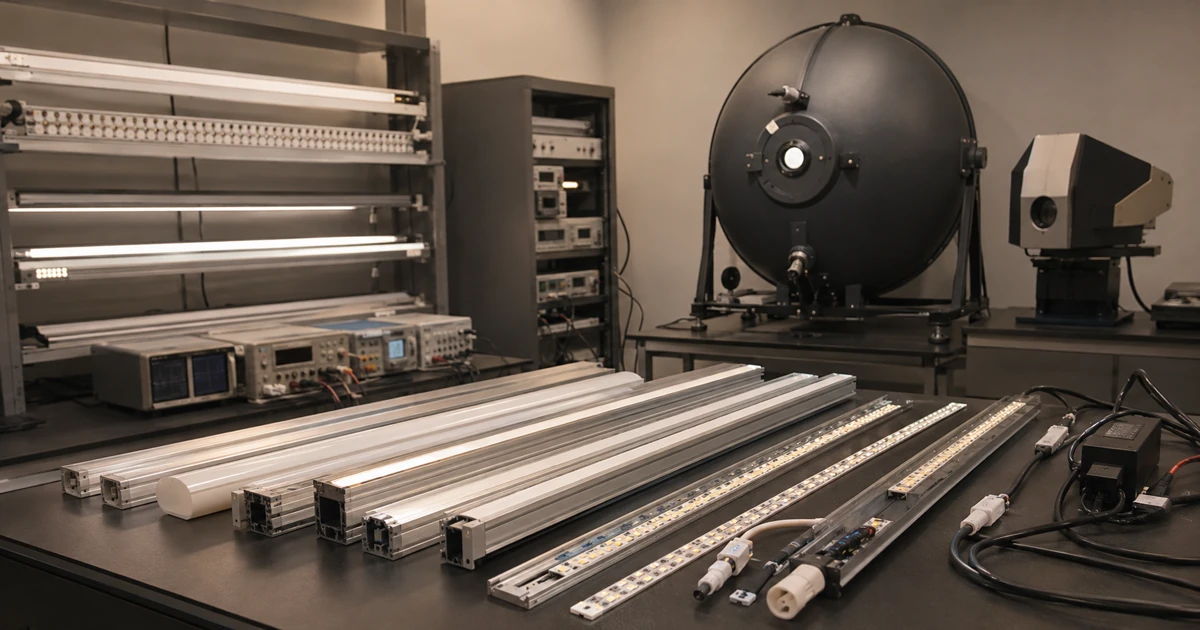
Figure: A replacement decision should compare electrical, optical, thermal, and control behaviour—not only the connector shape.
For a transparent bid comparison, use the same lifecycle model for both architectures:
TCO = purchase + installation + planned access + labour + spare parts + downtime + energy + end-of-life handling + future upgrade − residual value
Use project values rather than generic payback claims. For example, a facility team can compare the cost of one planned module change (module price, technician hours, access equipment, and post-replacement test) with the cost of removing, disposing of, and reinstalling a complete fitting. Run the comparison again at the expected replacement interval and include a sensitivity case for a longer spare-part lead time. This makes the decision auditable without inventing a universal saving percentage.
For a buyer-ready evaluation, request a supplier response against the same pass/fail fields: current interface and certification record; approved module-driver-optic combinations; photometric file for the installed configuration; colour data and tolerance; thermal limits; safe access and isolation procedure; replacement lead time; warranty responsibility; and the documents supplied at handover. Record the evidence-file name and revision for each answer. A missing field is not proof of failure, but it is an unresolved procurement risk that should be priced or clarified before award.
Common mistakes to avoid
Mistake 1: Treating a standard name as a performance guarantee
An interface specification can support fit and interoperability. It does not guarantee the same lumen package, colour, glare performance, or life claim across every module. Request system-level evidence.
Mistake 2: Buying the luminaire without the spare-part plan
A serviceable fitting without an identified replacement source is only nominally serviceable. Put the module code, lead time, storage conditions, and replacement procedure into the handover requirements.
Mistake 3: Ignoring access and isolation
A replaceable part still needs safe access. Confirm whether the fitting can be opened in place, how power is isolated, and whether the procedure is practical at the installed height.
Mistake 4: Replacing a module without rechecking the task
After replacement, inspect the fitting, verify electrical operation, and repeat the agreed photometric or visual checks. For critical areas, compare the replacement against the approved photometric file and neighbouring fittings.
How to write acceptance requirements
A useful acceptance clause describes observable evidence rather than promising a vague “future-proof” product. It can require:
- documentation of the interface, module, driver, and approved combinations;
- evidence of conformity or certification where claimed;
- photometric files for the installed configuration;
- colour and electrical data for the initial batch and replacement parts;
- a service procedure, access method, and safety instructions;
- a spare-parts and support plan for the expected operating period;
- commissioning records before and after any representative replacement.
For a multi-site project, add a component register with location, fitting identity, module identity, installation date, and replacement history. This turns serviceability into an auditable asset practice instead of a marketing adjective.
FAQ
Does an interchangeable interface guarantee equal performance?
No. It can define fit and electrical interface conditions, but buyers still need to verify photometry, colour, thermal limits, driver compatibility, safety documentation, and the intended application.
Is a modular luminaire always cheaper over its life?
No. The lifecycle result depends on module availability, service access, labour, records, downtime, and the cost of a complete replacement. Compare those assumptions with a sealed alternative before selecting an architecture.
What should be checked after a module is replaced?
Check safe installation and electrical operation, then repeat the agreed visual or photometric acceptance checks. Confirm that output, distribution, colour appearance, controls, and emergency functions still meet the project requirements.
What buyers should do next
The practical question is not whether every project should use interchangeable LED modules. It is whether the project’s risk profile rewards defined service access and component choice. Start with the spaces where access is expensive, downtime is disruptive, or future upgrades are likely. In a representative mock-up, record isolation and access time, replacement time, electrical and control behaviour, photometry or uniformity, colour comparison, emergency operation where relevant, documentation completeness, and total installed cost. Compare each result with the sealed-luminaire baseline before selecting an architecture.
When evaluating bids, give credit only to evidence that can be checked: interface documentation, tested combinations, photometric files, thermal limits, colour data, control behaviour, and a credible spare-parts route. That approach helps owners buy a lighting system that can be maintained deliberately rather than replaced reactively.
For a project-specific lifecycle comparison, contact TIMG with the proposed luminaire schedule, access constraints, and replacement assumptions.
Sources and review date
- April 2026 industry announcement, “linear socketable LED module certification ,” 13 April 2026. Supports the stated interface scope and certified connector/luminaire combination. Accessed 2 September 2026.
- European Commission, Light Sources: Ecodesign and energy labelling requirements . Accessed 2 September 2026.
This article is an industry procurement analysis, not a legal or conformity assessment. Recheck the applicable standard, product certification, local electrical requirements, and supplier documentation before specifying a project. Next review: 2 December 2026.