Power over Ethernet Lighting in 2026: Market Growth, Standards and What Buyers Need to Know
PoE Lighting Is Moving From Niche to Mainstream — Here Is Why It Matters
Power over Ethernet (PoE) lighting has been discussed in industry circles for several years, but 2026 marks a clear inflection point. The global PoE lighting market, valued at approximately USD 564 million in 2025, is projected to reach USD 704 million in 2026 and grow at a compound annual growth rate above 25% through the early 2030s, according to multiple market research sources.
That growth is not speculative. It is being driven by three converging forces: the maturation of the IEEE 802.3bt standard (delivering up to 90 watts per port), rising demand for smart building integration, and measurable cost advantages in new construction and major renovation projects.
For lighting buyers, specifiers, and building owners, the question is no longer whether PoE lighting works. It is whether it works for their specific project — and what trade-offs they need to understand before committing.
What PoE Lighting Actually Is — and What It Is Not
PoE lighting uses standard Ethernet cabling (Cat5e, Cat6, or Cat6a) to deliver both electrical power and data communication to LED luminaires from a centralized network switch, instead of running traditional AC electrical wiring to each fixture.
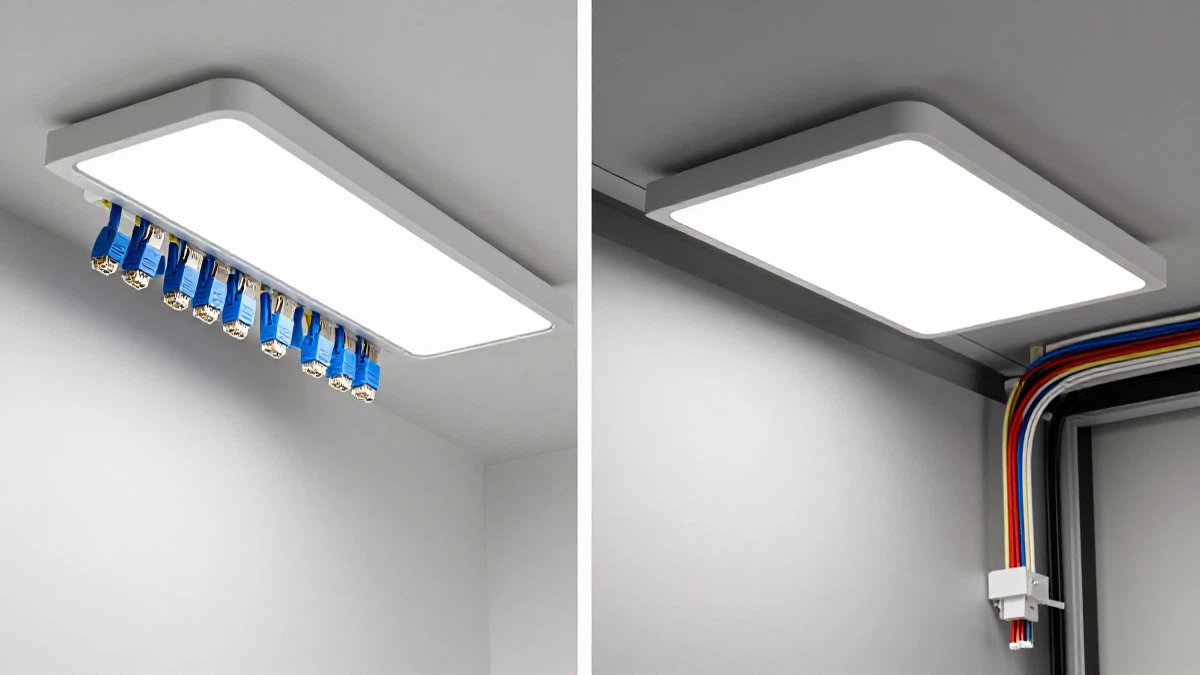
This is fundamentally different from conventional lighting installations, where each fixture requires a dedicated AC power line, a separate control wire (for dimming or switching), and often a home-run back to a distribution panel. In a PoE system, a single Ethernet cable carries power, dimming commands, occupancy sensor data, and daylight harvesting signals — all on one cable.
What PoE is not: a replacement for all lighting. High-wattage industrial fixtures, outdoor area lighting, and high-bay applications still require AC power. PoE is strongest in commercial interior environments — offices, conference rooms, hospitality corridors, retail displays, and educational spaces — where fixture wattages are moderate and control integration adds clear value.
The IEEE 802.3bt Standard Changed the Game
The original PoE standards (802.3af at 15.4W and 802.3at at 30W) were too limited for most lighting applications. A typical LED troffer or panel consumes 30–60 watts, which meant earlier PoE versions could only power small task lights or accent fixtures.
The IEEE 802.3bt standard, ratified in 2018 and now widely implemented in commercial switching equipment, changed this by supporting up to 90 watts per port (Type 3 at 60W and Type 4 at 90W). This power range covers the majority of commercial interior LED fixtures:
| Fixture Type | Typical Wattage | PoE Standard Required |
|---|---|---|
| Recessed LED downlight | 10–20W | 802.3at (PoE+) |
| LED panel / troffer (1×4, 2×4) | 30–50W | 802.3bt Type 3 |
| Linear LED pendant | 40–70W | 802.3bt Type 3–4 |
| LED track head | 15–30W | 802.3at (PoE+) |
| Decorative wall sconce | 8–15W | 802.3af (PoE) |
| High-bay LED | 150–300W | Not suitable for PoE |
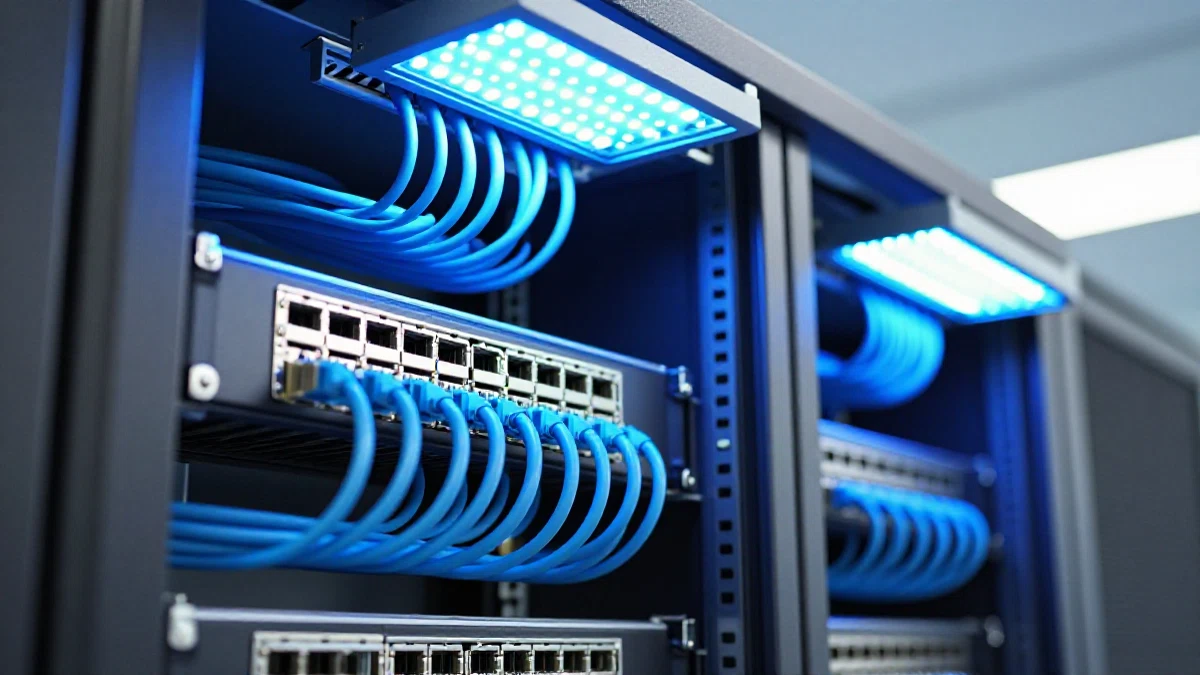
The 802.3bt standard also introduced improved power management features, including LLDP (Link Layer Discovery Protocol) negotiation, which allows the switch and fixture to communicate about actual power needs rather than always supplying maximum power. This reduces energy waste and heat generation in the cabling infrastructure.
Where PoE Lighting Saves Money — and Where It Does Not
Cost analysis is where many PoE discussions become oversimplified. The technology offers genuine savings in some areas and adds cost in others. Understanding the balance is essential for making a sound procurement decision.
Where PoE Reduces Cost
Installation labor: Running Cat6 cable to each fixture is significantly faster and cheaper than pulling conduit, running Romex, and making AC connections at each box. Multiple industry sources report that PoE installation labor is 60–80% lower than traditional AC wiring for comparable fixture counts. One analysis found that labor hours for PoE lighting installation were 80% less than for conventional electrical work.
Material cost: Ethernet cable is less expensive than electrical conduit, junction boxes, and separate control wiring. Raw material costs are typically 15–20% lower with PoE, though this varies by project.
Control system integration: Because PoE fixtures are natively connected to the network, there is no need for separate control wiring, gateway devices, or protocol translators. Occupancy sensing, daylight harvesting, scheduling, and dimming are all handled through the same Ethernet infrastructure. In traditional systems, adding these features requires dedicated control wiring and often a separate building automation system.
Flexibility for reconfiguration: In open-plan offices and retail environments where layouts change frequently, PoE fixtures can be moved or added by simply running a new Ethernet cable — no electrician required for the power connection. This is a meaningful advantage for tenants in commercial lease spaces.
Where PoE Adds Cost
PoE switches: The centralized network switches that deliver power to fixtures are more expensive than standard Ethernet switches. A 24-port PoE++ switch capable of delivering 90W per port can cost several thousand dollars. This is the single largest hardware cost difference between PoE and traditional lighting.
Fixture compatibility: Not all LED fixtures are available in PoE-compatible versions. Where they exist, PoE fixtures often carry a price premium of 10–20% over their AC-powered equivalents, due to the integrated PoE receiver and network interface.
Design and commissioning complexity: PoE lighting systems require coordination between electrical and IT teams during design and commissioning. The lighting designer needs to understand network topology, switch capacity planning, and VLAN configuration — skills that are not part of traditional lighting practice.
PoE vs Traditional AC Lighting: Side-by-Side Comparison
| Factor | PoE Lighting | Traditional AC Lighting |
|---|---|---|
| Wiring | Single Cat5e/6 cable per fixture | Separate power + control wiring |
| Installation labor | 60–80% lower | Baseline |
| Material cost | 15–20% lower (cable) | Baseline |
| Switch/gear cost | Higher (PoE++ switches) | Lower (standard panels) |
| Control integration | Native (no extra wiring) | Requires separate system |
| Fixture availability | Growing but limited | Universal |
| Max wattage per fixture | 90W (802.3bt Type 4) | No practical limit |
| Reconfiguration ease | High (plug and play) | Low (requires electrician) |
| IT/electrical coordination | Required | Minimal |
| Best application | Commercial interior, new construction | All applications |
Who Should Consider PoE Lighting — and Who Should Wait
PoE lighting makes the most sense in specific project contexts. Based on current market conditions and technology maturity, here is a practical assessment:
Strong fit:
- New commercial office construction where smart building features are planned from the start
- Major renovation projects where the entire electrical infrastructure is being replaced
- Tenant improvement projects in buildings with existing structured cabling infrastructure
- Projects that require granular lighting control, occupancy data, or integration with building management systems
- Facilities that value reconfiguration flexibility, such as co-working spaces and retail environments
Wait or proceed with caution:
- Retrofit projects where existing AC wiring is in good condition and control needs are simple
- Industrial and outdoor applications where fixture wattages exceed PoE limits
- Small projects where the fixed cost of PoE switches cannot be amortized across enough fixtures
- Projects where the local electrical and IT trades have no PoE lighting experience
- Regions where PoE-compatible fixture selection is limited and lead times are long
Key Questions Buyers Should Ask Before Choosing PoE
For procurement teams evaluating PoE lighting, these questions help separate genuine project value from vendor enthusiasm:
What is the total cost of ownership over 10 years? Include switch replacement cycles (network switches typically have shorter lifespans than electrical panels), software licensing for lighting management platforms, and IT support costs.
How many fixtures can each switch port support? Some low-wattage fixtures can be daisy-chained from a single port, which improves the economics. Understand the per-fixture switch cost, not just the per-port cost.
What happens when the network switch fails? In a PoE system, a switch failure can take down all fixtures connected to that switch. Understand the redundancy and failover strategy — do critical areas have backup power paths?
Who manages the system after installation? PoE lighting sits at the intersection of facilities management and IT. Clarify ownership, monitoring responsibilities, and software update processes before committing.
Are the fixtures I need available in PoE versions? Check availability and lead times for the specific fixture types, wattages, and finishes your project requires. Do not assume that any fixture can be specified in PoE.
What is the upgrade path? As PoE standards evolve and fixture efficiency improves, understand how the system can be upgraded without replacing the entire switching infrastructure.
Market Outlook: What to Expect Through 2028
The PoE lighting market is expected to continue growing at 25–30% annually through at least 2028, driven by several factors:
- Smart building mandates are expanding in major markets, particularly in the EU and North America, where new energy performance standards increasingly favor integrated lighting and building management systems
- IEEE 802.3bt adoption is accelerating as switch prices decline and more manufacturers offer PoE-compatible fixtures across broader product categories
- Data-driven building management is becoming standard practice in commercial real estate, and PoE lighting provides the sensor infrastructure (occupancy, ambient light, space utilization) that makes data-driven operations possible
- Sustainability reporting requirements are pushing building owners toward systems that can document energy use and occupancy patterns at the fixture level — something PoE lighting does natively
However, PoE lighting is unlikely to replace traditional AC lighting entirely. The technology will continue to coexist with conventional systems, with PoE capturing a growing share of new commercial interior projects while traditional wiring remains dominant in industrial, outdoor, and retrofit applications.
Conclusion
PoE lighting in 2026 is a mature, viable technology with clear advantages in specific project contexts — particularly new commercial construction where smart building integration, installation efficiency, and reconfiguration flexibility are priorities. The cost equation has improved significantly with IEEE 802.3bt, and the market is growing rapidly.
But PoE is not a universal upgrade. It adds complexity in IT coordination, requires careful switch capacity planning, and is limited to fixtures below 90 watts. For buyers and specifiers, the right approach is to evaluate PoE on a project-by-project basis, comparing total cost of ownership against traditional systems rather than assuming that newer always means better.
The strongest outcomes come from projects that start with the application need — not the technology label — and choose PoE because it solves real problems in lighting control, installation efficiency, or building data integration that traditional wiring cannot address as effectively.
Related Reading: