Lighting as a Service (LaaS): Why Commercial Buyers Are Shifting From CAPEX to OPEX
Lighting as a Service Is Reshaping How Commercial Buildings Buy and Manage Light
For decades, commercial lighting has been straightforward: capital expense. A facility manager or building owner budgeted for luminaires, ballasts, wiring, and controls. They purchased inventory, managed replacements, and tracked depreciation. Today, a growing segment of commercial buyers is moving away from that ownership model entirely.
Lighting as a Service (LaaS) — a subscription-based approach where a service provider owns, installs, maintains, and manages the entire lighting system — has grown from a niche proposition to a mainstream procurement option. In 2024, approximately 7% of commercial lighting buyers in major markets had adopted LaaS models. By 2026, that figure has reached 18%, with adoption accelerating in commercial real estate, retail, hospitality, and institutional facilities. The market is projected to grow at a 32% compound annual growth rate through 2028, according to industry analysts tracking facility management trends.
This shift is not driven by technology alone. It is driven by three converging pressures: the need to move capital expenditure off the balance sheet, increasing requirements to demonstrate environmental sustainability and ESG compliance, and the operational burden of lighting maintenance in an era of labor scarcity and rising energy costs.
For procurement teams, facilities managers, and building owners considering LaaS, the question is no longer whether the model works — it is whether it works for your specific facility, and what financial and operational trade-offs you need to understand before committing.
What Is Lighting as a Service, and How Does It Differ From Traditional Lighting Procurement?
Lighting as a Service is fundamentally a different ownership and financing model for lighting. Rather than purchasing luminaires and controls as capital assets, the facility contracts with a service provider who remains the legal owner of the lighting system throughout the contract term.
Under a typical LaaS arrangement:
- The service provider installs new or upgraded LED fixtures, wiring, controls, and management systems at no upfront capital cost to the facility.
- The facility pays a monthly subscription fee — typically expressed as a per-fixture charge, a per-square-foot charge, or a lump monthly payment — that covers installation, all maintenance, repairs, lamp and ballast replacement, and software licensing for controls and monitoring.
- The provider assumes responsibility for system performance, energy efficiency targets, uptime guarantees, and regulatory compliance.
- The facility receives a turnkey lighting system with no capital budget impact, predictable operating costs, and full performance guarantees.
At contract end (typically 5-10 years), the service provider either upgrades the system to current technology standards or removes it, depending on the contract terms and the facility’s needs.
This differs from traditional ownership in several critical ways:
In traditional procurement, the facility owns the assets, manages maintenance, assumes replacement risk, and carries depreciation on the balance sheet. Upfront costs are high, ongoing maintenance is often deferred or inconsistent, and as technology advances, the system becomes increasingly outdated.
In a LaaS model, the facility is a subscriber to a service, not a holder of depreciating assets. Operating costs are predictable, maintenance is guaranteed, technology upgrades are planned, and the lighting system is continuously optimized for energy and performance.
The Market Drivers Behind LaaS Growth: Why Now?
Three structural shifts in commercial real estate and facility management have converged to make LaaS viable at scale.
1. CAPEX-to-OPEX Conversion and Balance Sheet Management
For many commercial property owners and large facility operators, converting a major capital expense into a predictable operating expense has significant financial benefits.
Traditional lighting upgrade: A 100,000-square-foot office building might invest $300,000–$500,000 in a new lighting system, with the cost capitalized over 10–15 years. This ties up capital, requires debt or cash reserves, and reduces financial flexibility.
LaaS equivalent: The same facility pays a monthly subscription of $3,000–$5,000 (depending on system scope, efficiency targets, and service levels), treating the cost as an operating expense that flows directly through the P&L. No capital budget required, no balance sheet impact, and the cost can be adjusted or terminated if building occupancy changes.
For real estate investment trusts (REITs), multi-property operators, and private equity-backed facilities, this operational structure is increasingly attractive. It improves return on invested capital metrics, simplifies financial forecasting, and reduces the cost of debt by lowering the asset base.
2. Environmental, Social, and Governance (ESG) Compliance and Sustainability Reporting
Many large commercial property owners now face investor demands, tenant expectations, and regulatory requirements to reduce energy consumption, measure and report greenhouse gas emissions, and demonstrate progress toward net-zero targets.
LaaS providers, because they retain ownership of the lighting system and assume financial responsibility for energy performance, have strong incentives to optimize efficiency continuously. Many LaaS contracts include energy performance guarantees — commitments that the installed system will achieve specified reductions in lighting energy consumption, with financial penalties if the targets are missed.
For building owners, this creates a direct alignment of interests. The service provider benefits financially from energy savings, so they specify high-efficiency LEDs, invest in occupancy-sensing controls, and optimize the system for daylight harvesting and demand-responsive dimming. The facility owner benefits from reduced operating costs and documented energy reductions that can be reported in ESG disclosures.
In jurisdictions with carbon pricing schemes or energy performance standards for buildings, this alignment is particularly valuable. Facilities that can demonstrate measurable energy reductions have lower compliance costs and competitive advantage in leasing to sustainability-conscious tenants.
3. Labor and Maintenance Complexity in an Era of Technical Specialization
As lighting systems have become more sophisticated — with smart controls, occupancy sensors, daylight harvesting, and integration with building management systems — the skill set required to maintain them has expanded well beyond traditional electrician training.
Facilities often lack in-house expertise to troubleshoot LED driver failures, reprogram occupancy thresholds, update firmware on networked controls, or integrate new sensors into building automation. Hiring and retaining specialized lighting technicians is expensive, and geographic availability is uneven.
A LaaS provider, by managing multiple facilities across a region or nationally, can deploy specialized teams efficiently, spread training and certification costs across many properties, and maintain expertise that any single facility would struggle to justify. This is particularly valuable for facilities that have experienced staff turnover or lack dedicated maintenance resources.
How LaaS Contracts Are Structured: Key Terms and Variations
LaaS arrangements vary significantly in scope, term, and financial structure. Understanding common variations is essential for procurement teams evaluating options.
Monthly Subscription Models
Per-fixture pricing: The facility pays a fixed monthly fee per installed fixture (typically $5–$15 per fixture per month, depending on fixture type, control complexity, and service level). This model works well when fixture counts are stable and the facility wants simple, predictable costs.
Per-square-foot pricing: The facility pays a monthly fee based on facility square footage (typically $0.05–$0.15 per square foot per month). This model scales automatically if the facility adds or subtracts space, making it attractive for tenants in shared buildings or multi-location operators with variable real estate portfolios.
All-in monthly payment: The facility pays a fixed monthly amount that covers all lighting costs (fixtures, controls, maintenance, energy savings guarantees, and software). This is common for large, multi-property arrangements where a single contract can be negotiated for an entire portfolio.
Contract Term and Flexibility
Standard LaaS contracts run 5–10 years. Shorter terms (3–5 years) carry higher monthly costs because the provider must recover equipment investment faster. Longer terms (10+ years) can offer lower monthly costs but reduce flexibility if business conditions change.
Some providers now offer flexible terms with early termination options (at a penalty fee) or automatic technology refresh clauses that allow the facility to upgrade to newer, more efficient lighting as technology advances.
Performance Guarantees and Service Levels
LaaS contracts typically include:
- Energy savings guarantees: The provider commits to achieving specified lighting energy reductions (e.g., 40% reduction compared to baseline), with financial adjustments if actual savings fall short.
- Uptime and maintenance commitments: Guarantee that a certain percentage of fixtures will be operational at all times (e.g., 99% uptime), with penalties for extended outages.
- Response time commitments: The provider commits to respond to maintenance requests within a specified timeframe (e.g., 24–48 hours) and complete repairs within a defined window (e.g., 2 weeks).
- Efficiency performance: Commitment that the system will maintain rated lumen output and efficacy throughout the contract term, with scheduled relamping or fixture replacement if performance degrades below contractual levels.
These guarantees protect the facility, but they also create ongoing revenue risk for the provider. Procurement teams should understand which guarantees matter most for their facility and negotiate accordingly.
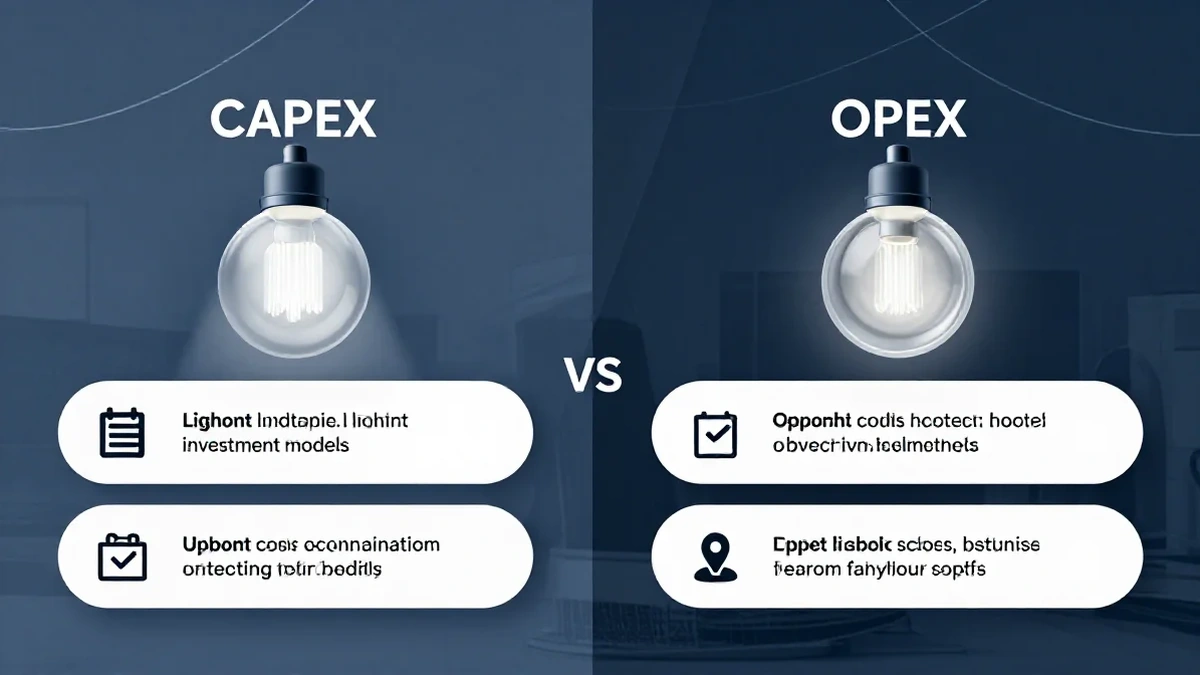
Financial Comparison: CAPEX Ownership vs. OPEX Subscription
To evaluate whether LaaS makes financial sense for a specific facility, a detailed total cost of ownership (TCO) comparison is essential. The calculation depends on several variables: facility size, current lighting efficiency, electricity rates, labor costs, discount rates, and contract terms.
Side-by-Side Cost Comparison
| Cost Category | Traditional CAPEX Ownership | LaaS Subscription Model |
|---|---|---|
| Initial capital investment | $250,000–$500,000 upfront | $0 (no upfront cost) |
| Monthly/annual operating cost | $0–$5,000/year maintenance + energy | $3,000–$8,000/month all-inclusive |
| Maintenance and repairs | Self-managed or contract; unpredictable | Included; guaranteed response times |
| Relamping and fixture replacement | Facility responsibility; ongoing expense | Included in service contract |
| System upgrades | Facility must invest additional capital | Refresh included or negotiated separately |
| Energy costs | Facility bears all energy risk | Provider assumes part of energy risk |
| Balance sheet impact | Capital asset capitalized over 10–15 years | Operating expense; off-balance-sheet |
| Residual value at contract end | Facility retains old equipment | Provider removes or upgrades |
| Technology obsolescence risk | Facility bears depreciation and replacement risk | Provider assumes modernization risk |
Detailed 10-Year TCO Example
Consider a 75,000-square-foot office building currently using a mix of older fluorescent and LED fixtures.
Traditional ownership scenario:
- Baseline energy for lighting: 150,000 kWh/year at $0.12/kWh = $18,000/year
- Year 1 capital investment (new LED system): $350,000
- Annual maintenance and relamping (outsourced): $5,000/year
- Energy savings from new LEDs (25% reduction): $4,500/year
- Net annual energy cost after upgrade: $13,500/year
- Facility electrician labor (0.5 FTE): $50,000/year
10-year cost:
- Capital investment: $350,000
- Maintenance and repairs: $50,000
- Electrician labor (partial): $200,000 (assuming 30% time allocation to lighting after first year)
- Energy costs: $137,500 ($13,500 baseline minus some reductions from aging-in-place LED swaps)
- Total 10-year cost: $737,500
LaaS subscription scenario:
- Monthly subscription: $4,500 (approximately $0.06/sq ft/month for 75,000 sq ft)
- Provider includes: LED fixtures, controls, maintenance, relamping, monitoring, energy optimization
- No capital investment
- Annual energy cost during LaaS period: $7,500 (baseline reduced further due to aggressive provider optimization)
- Facility labor for lighting coordination: 0.1 FTE = $8,000/year
10-year cost:
- Monthly subscription (5-year contract): $4,500 × 60 months = $270,000
- Years 6–10: Facility either renews contract or exits; assume 5-year renewal at slightly higher rate due to inflation: $4,800 × 60 months = $288,000
- Coordination labor: $8,000 × 10 years = $80,000
- Energy costs during LaaS period: $75,000
- Total 10-year cost: $713,000
Net difference: LaaS is approximately $24,500 cheaper (3.3% savings) over 10 years, without the upfront capital requirement. In NPV terms (discounting at 8% annual rate), the advantage is larger because the facility avoids the capital investment.
Critically, the facility also:
- Requires no $350,000 upfront capital
- Avoids the need to manage a 0.5 FTE electrician role dedicated to lighting
- Transfers technology obsolescence risk to the provider
- Receives guaranteed energy performance and uptime
If the facility has access to cheap capital (e.g., a REIT with a 4% borrowing rate), traditional ownership might be marginally cheaper in pure financial terms. But if capital is expensive, the balance sheet impact is important, or the facility lacks in-house maintenance expertise, LaaS becomes financially superior.
LaaS Use Cases: Where It Works Best
LaaS is not universally optimal. It works best in specific facility contexts.
Excellent fit:
- Multi-site corporate facilities: Companies with 5+ locations benefit from aggregated contracts, simplified accounting, and centralized monitoring of energy and maintenance across all properties.
- Retail and hospitality chains: These facilities have high maintenance requirements (frequent tenant changes, high occupancy hours, complex control demands), making a managed service attractive.
- Financial services and corporate offices with aggressive ESG targets: These facilities have sustainability reporting requirements and investor pressure to reduce energy use, and they value the guaranteed energy savings and transparency that LaaS providers can deliver.
- Facilities with aging infrastructure and uncertain capital budgets: Buildings where lighting deferred maintenance is severe but capital is constrained benefit from LaaS’s ability to upgrade systems without budget impact.
Moderate fit:
- Educational institutions: Schools and universities often have deferred maintenance and constrained capital budgets, but they also have long-term occupancy stability and may benefit from in-house facility expertise.
- Healthcare facilities: Hospitals and clinics have complex lighting demands and high maintenance costs, but many have access to low-cost capital through bonds or government facilities programs.
- Large government buildings: These facilities have stable occupancy and standardized maintenance protocols, but rigid procurement rules and long replacement cycles can complicate LaaS contracts.
Poor fit:
- Small, single-location facilities with stable occupancy and low maintenance complexity: These facilities may not generate enough scale to justify the service provider’s overhead.
- Facilities with existing, recent lighting investments: If a facility upgraded lighting within the past 3–5 years, the TCO comparison usually favors retaining the existing system.
- Facilities in regions with very high or very low electricity costs: If electricity is extremely cheap, energy efficiency is less valuable; if extremely expensive, the facility may already have optimized lighting heavily.
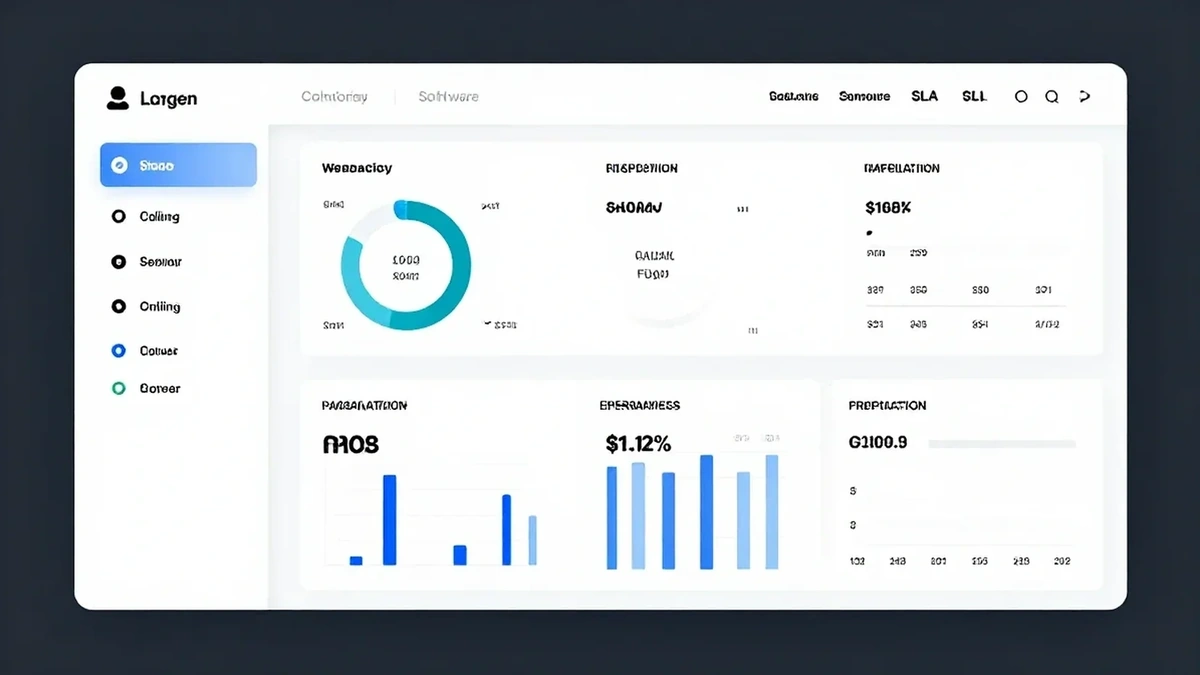
Contract Structure and Key Negotiation Points
Facility managers evaluating LaaS should pay attention to several critical contract elements.
1. Energy Savings Guarantees
What to look for: Clear definition of the baseline energy consumption (e.g., “pre-existing fixtures measured over 12 months at average occupancy”), the guaranteed savings target (e.g., “40% reduction”), and the mechanism for adjusting guarantees if facility operations change (e.g., expansion, occupancy reduction).
Red flags: Vague baseline definitions, guarantees that don’t account for changes in operating hours or occupancy, or penalties that are too severe if targets are missed.
2. Maintenance Response and Uptime
What to look for: Specific response times (e.g., “respond to emergency outages within 4 hours, complete repairs within 48 hours”) and uptime guarantees that reflect your facility’s criticality (e.g., “99% fixture uptime” for a retail space, “99.9%” for a hospital).
Red flags: Vague language like “timely maintenance” or uptime guarantees that are difficult to measure, or response time commitments that conflict with your facility’s operational needs.
3. System Upgrades and Refresh Cycles
What to look for: Clear timeline for upgrading luminaires as technology advances, and the cost (if any) to the facility for upgrades beyond the base contract. As LED efficiency continues to improve , facilities want to ensure they benefit from new technology.
Red flags: No provisions for system upgrades, or upgrade costs that are borne entirely by the facility, defeating the purpose of a managed service.
4. Termination and Residual Value
What to look for: Clear exit terms, including whether the facility can terminate early (at what penalty), what happens to the system at contract end (removal, donation, transfer of ownership), and any residual value or salvage terms.
Red flags: Contracts with punitive early termination costs, or unclear provisions about who owns fixtures at the end of the term.
5. Technology and Controls Integration
What to look for: Confirmation that the LaaS provider’s controls and monitoring systems can integrate with your existing building management infrastructure, or clarity about what new systems will be installed and who manages them.
Red flags: Proprietary control systems that lock you into the provider, or lack of clarity about data ownership and access.
Frequently Asked Questions About Lighting as a Service
1. Does a LaaS contract lock me into a specific provider for years? Can I switch providers early if I’m unhappy?
Most LaaS contracts run 5–10 years with early termination options. However, early exit typically comes with financial penalties — either a lump-sum buyout of remaining contract value or a monthly surcharge for the remainder of the original term.
The penalty amount varies widely and is negotiable. Some providers offer “hard exits” with modest penalties ($5,000–$15,000) if specific performance targets are missed; others charge 6–12 months of remaining payments.
Before signing, understand the exact early termination costs and the conditions that trigger penalty-free exit. Also clarify what happens to the installed fixtures if you exit early — does the provider remove them, or does ownership transfer to the facility?
2. What performance guarantees do providers typically offer, and what happens if they don’t meet them?
Standard guarantees include:
- Energy savings: Usually 30–50% reduction in lighting energy compared to a defined baseline, verified through utility bills or sub-metered data
- Uptime: Typically 98–99.5% fixture availability, with target response times for repairs (24–48 hours)
- Lumen maintenance: Commitment that fixtures will maintain 90–95% of rated light output at end of contract
- Rebate pass-through: If rebates from utilities or government incentive programs are available, the provider passes a portion to the facility
If the provider fails to meet guarantees, remedies are usually credits applied to the next month’s invoice or contract extension at no cost. Some providers offer service credits up to 10% of monthly fees if response time commitments are missed.
Critically, verify that guarantees are verifiable — include specific measurement methods (e.g., which utility meter is used, how occupancy changes are accounted for) so you can actually measure performance.
3. Can I choose my own fixtures and controls, or does the provider dictate the system design?
This depends on the contract structure. In many LaaS arrangements, the provider specifies fixtures and controls because they are assuming responsibility for performance and maintenance. The provider wants to install systems they understand and can service reliably.
However, large facilities or multi-site operators often negotiate custom designs. If your facility has specific requirements — certain fixture aesthetics, integration with particular controls protocols, or performance specs — those can be incorporated into the contract.
The tradeoff is that custom designs may increase costs or complicate performance guarantees. Standard, off-the-shelf systems are cheaper and easier to service; customization adds cost and risk.
Recommendation: Identify your non-negotiable requirements (e.g., “controls must integrate with our BMS via DALI-2”) early in the negotiation. The provider can then design within those constraints.
4. What if my building’s occupancy or operating hours change significantly? Can the subscription costs be adjusted?
Most LaaS contracts include provisions for adjusting costs if facility conditions change materially. However, the specific mechanism varies.
Some contracts use a per-fixture pricing model, which scales automatically if you add or remove fixtures. Others use per-square-foot pricing, which adjusts if the facility expands or contracts.
All-in fixed monthly payments typically include adjustment clauses triggered by major changes — e.g., if occupancy drops below 50% of baseline, the provider offers a reduced rate. Similarly, if operating hours increase substantially, the facility might pay a higher monthly fee because the system runs longer and requires more maintenance.
Recommendation: Before signing, negotiate clear definitions of what changes trigger cost adjustments and how those adjustments are calculated. Vague language about “significant changes” will create disputes later.
5. Who owns the data generated by the lighting system — occupancy patterns, energy consumption, facility utilization?
This is increasingly important as lighting systems generate rich data about facility usage. Some LaaS contracts treat data as the facility’s property (which is correct), while others claim ownership or rights to de-identified, aggregated data.
Recommendation: Ensure the contract explicitly states that the facility owns all data generated within the facility, and that the provider may only use aggregated, anonymized data for benchmarking or service optimization. Also clarify whether the facility has access to raw data for building analytics, ESG reporting, or operational decisions.
If the provider wants to retain data rights for their own machine learning or benchmarking purposes, require explicit opt-in language and the ability to opt out without penalty.
6. What happens if the provider goes out of business or stops serving my region?
This is a critical risk that is often overlooked. If your LaaS provider files bankruptcy or exits your market, your lighting system might be orphaned — the service provider’s team stops responding to maintenance requests, software support ends, and you’re responsible for managing the system yourself.
Recommendation: Before signing, research the provider’s financial stability and history. Ask for references from facilities in your region that have been with the provider for 3+ years. Also negotiate explicit provisions in the contract for transition support — e.g., “If the provider exits, they will transition all system documentation, spare parts inventory, and software access to the facility at no cost within 30 days.”
Some providers offer escrow accounts that hold spare parts or source code, ensuring that even if the company fails, your system can be maintained. This is worth negotiating if you’re signing a 10-year contract.
The LaaS Provider Landscape: Key Players and Market Dynamics
As of 2026, the LaaS market includes:
- Specialized lighting service providers: Companies founded specifically to offer LaaS, often backed by private equity or venture capital. These tend to have sophisticated technology platforms and national or global reach.
- Traditional lighting manufacturers: LED and luminaire companies that have launched service divisions to capture recurring revenue.
- Facilities management companies: Large facilities management firms that offer LaaS as part of a broader portfolio of services (HVAC, security, maintenance).
- Energy service companies (ESCOs): Providers that offer LaaS as part of broader energy efficiency programs, often bundling it with HVAC and building envelope improvements.
Each category has different strengths:
- Specialized providers typically offer the most sophisticated controls technology and data analytics, but they may have limited geographic reach or service experience.
- Traditional manufacturers understand product quality and can offer familiar equipment, but service delivery may be less robust.
- Facilities management companies can bundle lighting with other services, reducing coordination overhead, but lighting may not be their primary focus.
- ESCOs can bundle lighting with other energy efficiency measures, potentially creating larger energy savings, but their service model may be designed for larger facilities.
When evaluating providers, assess not just their current capabilities but their likely market position in 3–5 years. The LaaS market is consolidating; some providers will dominate, while others will exit or be acquired. Signing a contract with a provider you believe will remain viable and well-capitalized reduces your transition risk.
Key Considerations for Procurement Teams
If you are evaluating LaaS for your facility, focus on these elements:
Calculate your specific TCO: Generic comparisons are useful, but your facility’s age, current efficiency, occupancy patterns, and maintenance costs are unique. Build a detailed 10-year model comparing LaaS against traditional ownership for your actual building.
Define your performance non-negotiables: Energy savings, uptime, response times, and controls integration requirements should be specific and measurable. Vague guarantees are unenforceable.
Understand the exit costs: Early termination penalties, transition costs, and residual value arrangements should be crystal clear before you sign.
Verify the provider’s financial stability and service track record: Check references from similar facilities, review years of consistent operation, and evaluate the provider’s balance sheet if possible.
Align incentives: The best LaaS contracts create shared incentives — the provider benefits from energy savings and uptime, and the facility benefits from lower costs and better service. If the contract structure means the provider only benefits from keeping the monthly fee high, incentives are misaligned.
Conclusion: LaaS Is Now a Viable Alternative to Traditional Lighting Procurement
Lighting as a Service has moved from experimental to mainstream in 2026. Eighteen percent of commercial lighting buyers have adopted LaaS models, adoption is accelerating, and the financial and operational case is strong for many facility types.
LaaS works best for facilities that want to convert capital expense into predictable operating expense, need to demonstrate measurable energy reductions for ESG compliance, lack in-house maintenance expertise, or want guaranteed system performance without assuming ownership risk.
It is not universally optimal — smaller facilities, buildings with recent lighting investments, or facilities with abundant low-cost capital might still prefer traditional ownership. But for mid-size to large commercial properties with multiple locations, existing maintenance challenges, or aggressive energy targets, LaaS deserves serious evaluation.
The key to successful adoption is moving beyond high-level marketing claims and conducting a detailed financial analysis specific to your facility, negotiating contract terms that protect your interests and align incentives with the provider, and selecting a provider with demonstrated financial stability and service quality.
If you are responsible for lighting procurement or facility management, consider reaching out to a qualified lighting service provider to discuss your facility’s specific needs, request a detailed LaaS proposal with transparent cost modeling and performance guarantees, and compare the results against your traditional ownership TCO. The analysis will show whether LaaS is a financial winner for your building.
Related Reading
- LED Efficiency Breakthrough 2026: What Buyers Need to Know About the Latest Technology Gains
- 2026 Q1 Commercial Lighting Procurement Trends: Controls, Retrofit & Supply Chain
- Power over Ethernet Lighting in 2026: Market Growth, Standards and What Buyers Need to Know