LED Efficiency Breakthrough 2026: What Buyers Need to Know About the Latest Technology Gains
Why LED Efficiency Matters Again in 2026
For several years, LED efficiency improvements seemed to plateau. Commercial products settled around 130-160 lm/W, and the conversation shifted toward controls, color quality, and smart features. In 2026, that trend has reversed. Laboratory breakthroughs, new phosphor formulations, and tightening regulations have pushed efficiency back to the center of procurement discussions.
The stakes are higher now. EU energy efficiency requirements are increasing from 1.3% annual savings (2024-2025) to 1.5% in 2026-2027. US standards continue to tighten for general service lamps. For commercial buyers, the efficiency of a lighting system directly affects operating costs, compliance risk, and long-term replacement cycles.
This article explains what has changed in LED efficiency during 2026, how new technologies perform, and what procurement teams should consider when evaluating high-efficiency claims.
The Current State of LED Efficacy in 2026
Commercial Products
The best commercially available LED products now reach up to 230 lm/W in real-world conditions, nearly double the average from 2015. This is not laboratory data — it is what buyers can specify today for street, industrial, and high-bay applications.
For context:
- 2010: average commercial LED efficacy was below 75 lm/W
- 2015: average reached approximately 100-120 lm/W
- 2020: typical high-efficiency products achieved 150-170 lm/W
- 2026: top-tier products now reach 200-230 lm/W
This matters because every 10 lm/W improvement translates to measurable energy savings over the life of an installation. A facility replacing 1000 fixtures at 150 lm/W with 200 lm/W equivalents can reduce lighting energy consumption by approximately 25%, assuming equivalent light output.
Laboratory Records
In controlled testing, researchers have achieved 303 lm/W for white power LEDs, setting a new industry benchmark. While laboratory results do not directly translate to commercial products, they indicate the technical ceiling that future products will approach.
The gap between lab records and commercial products has historically been 5-8 years. The 303 lm/W achievement suggests that 250+ lm/W commercial products could become realistic by 2030-2032.
Three Technology Drivers Behind the 2026 Breakthrough
1. Micro-LED Advances
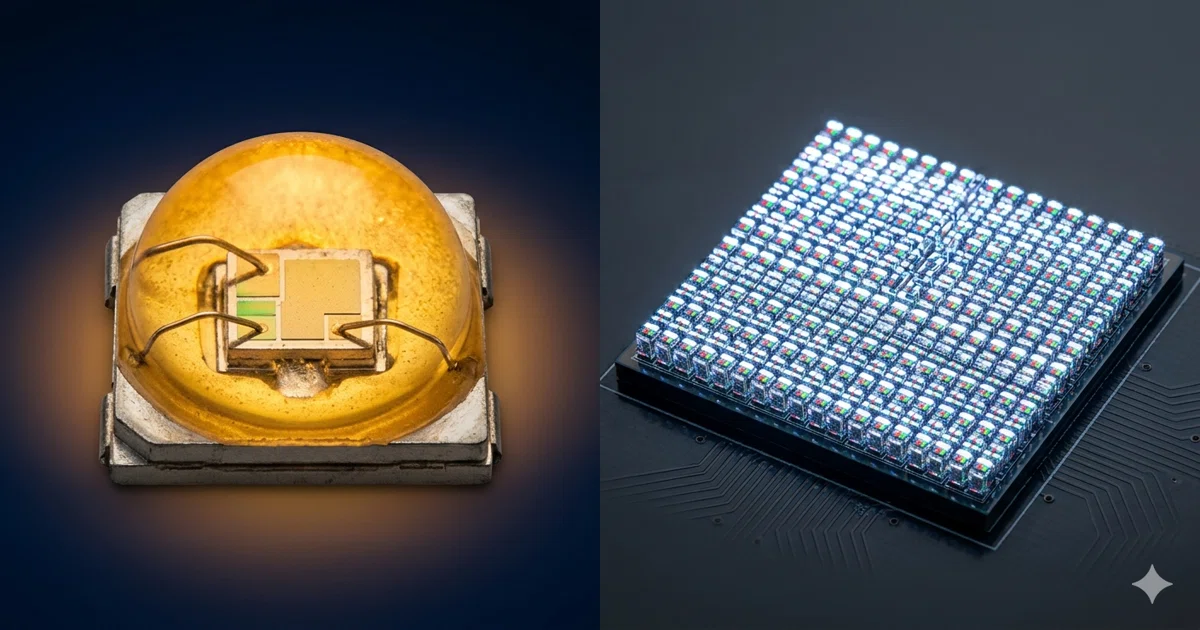
Micro-LED technology, originally developed for displays, is now influencing general lighting efficiency. By reducing chip size to below 100 micrometers, manufacturers can achieve:
- Higher current density efficiency: smaller chips can be driven harder without the same efficiency droop seen in larger LEDs
- Better thermal management: reduced thermal resistance per unit of light output
- Improved light extraction: less internal reflection and absorption losses
For buyers, micro-LED-based luminaires are still emerging in general lighting. The technology is more established in specialty applications (automotive, high-density displays) but is beginning to appear in premium architectural and commercial products.
What to check: When a supplier claims micro-LED technology, ask for specific efficacy data at operating current, not just peak values. Micro-LED efficiency gains are real, but they depend heavily on driver design and thermal implementation.
2. New Phosphor Formulations
Traditional white LEDs use a blue LED chip with a yellow phosphor coating (YAG:Ce). This approach has efficiency limits because of Stokes shift losses — energy lost when converting higher-energy blue photons to lower-energy yellow photons.
New phosphor technologies in 2026 include:
- Narrow-band red phosphors: reduce energy waste by emitting red light more precisely where needed, improving overall system efficacy by 5-10%
- Green phosphor improvements: address the “green gap” where LED efficiency has historically been lower, enabling better full-spectrum white light with less energy loss
- Quantum dot hybrid approaches: combine traditional phosphors with quantum dots for more precise spectral control
These improvements are already appearing in commercial products. High-CRI luminaires that previously sacrificed 10-15% efficacy for color quality can now achieve 90+ CRI with minimal efficiency penalty.
What to check: Ask suppliers about phosphor type when evaluating high-CRI products. Newer formulations can deliver both color quality and efficiency; older designs force a trade-off.
3. Driver and System Integration
LED efficiency is not determined by the LED chip alone. Driver efficiency, optical losses, and thermal design all affect the final system efficacy.
In 2026, driver technology has improved significantly:
- GaN-based drivers: achieve 95-97% efficiency, compared to 85-90% for traditional silicon-based designs
- Improved dimming efficiency: modern drivers maintain high efficiency across dimming ranges, where older designs lost 10-20% at partial output
- Better thermal management: integrated heat sink designs that maintain LED junction temperatures 10-15°C lower than previous generations
For procurement teams, this means that comparing LED package efficacy alone is insufficient. A 200 lm/W LED chip with a poor driver and bad thermal design can underperform a 170 lm/W chip in a well-engineered system.
What to check: Request system efficacy data (luminaire lm/W), not just LED package efficacy. The difference between the two reveals the quality of driver, optics, and thermal design.
2026 EU and US Efficiency Regulations: What Changes
EU Energy Efficiency Directive Updates
The EU Energy Efficiency Directive has increased annual energy savings obligations for member states:
- 2021-2023: minimum 0.8% of final energy consumption
- 2024-2025: minimum 1.3%
- 2026-2027: minimum 1.5%
- 2028-2030: minimum 1.9%
For commercial building operators, this translates to:
- Stricter compliance requirements: buildings must demonstrate measurable efficiency improvements
- Higher scrutiny on lighting upgrades: lighting is one of the easiest areas to document energy savings, making it a priority for compliance
- Incentive alignment: many EU member states offer rebates or tax benefits for high-efficiency lighting that exceeds minimum requirements
US DOE Standards
The US Department of Energy continues to update energy conservation standards for general service lamps. While specific 2026 requirements vary by product category, the trend is clear:
- Minimum efficacy requirements continue to rise
- Products that do not meet new standards face market access restrictions
- Utility rebate programs increasingly require efficiency levels above federal minimums
What this means for buyers: Specifying products that merely meet current minimums may create compliance risk within 2-3 years. Products that exceed minimums by 20-30% provide a buffer against regulatory changes and maintain rebate eligibility.
Total Cost of Ownership: Why Higher Efficiency Pays
The Math Behind Efficiency Upgrades
For commercial buyers, the key question is whether higher-efficiency products justify their typically higher upfront cost. The calculation depends on:
- Operating hours: facilities with longer hours see faster payback
- Electricity rates: higher rates accelerate ROI
- Installation scale: larger projects benefit more from efficiency gains
- Rebates and incentives: can offset 20-50% of premium costs
Example calculation:
A warehouse operates 4000 hours/year with electricity at $0.12/kWh. Replacing 500 fixtures:
| Scenario | Efficacy | Wattage per fixture | Annual energy cost | 10-year energy cost |
|---|---|---|---|---|
| Standard LED | 150 lm/W | 200W | $48,000 | $480,000 |
| High-efficiency LED | 200 lm/W | 150W | $36,000 | $360,000 |
| Savings | — | 50W reduction | $12,000/year | $120,000 |
If high-efficiency fixtures cost 30% more upfront ($150 vs $115 per fixture), the premium is $17,500. Payback occurs in approximately 1.5 years. Over 10 years, net savings exceed $100,000.
Beyond Energy: Maintenance and Replacement
Higher-efficiency LEDs often run cooler, which can extend driver and component life. This creates secondary savings:
- Longer replacement cycles: fewer maintenance calls and replacement purchases
- Reduced labor costs: less frequent relamping in hard-to-reach installations
- Lower failure risk: cooler operation reduces thermal stress on components
What to check: Ask suppliers for operating temperature data and projected L70 life at actual operating conditions. Products that achieve high efficiency through aggressive driving (overdriving LEDs) may sacrifice lifespan.
Five Common Mistakes Buyers Make When Evaluating Efficiency Claims (FAQ)
1. Focusing Only on Package Efficacy
LED package efficacy is measured under ideal conditions. Real-world luminaire efficacy includes driver losses, optical losses, and thermal effects. A 200 lm/W LED package can result in a 150 lm/W luminaire if the system design is poor.
Correct approach: We recommend always comparing luminaire efficacy (total light output divided by total input power), not LED package specifications.
2. Ignoring Efficiency at Dimmed Levels
Many commercial spaces operate lighting at less than full output for significant portions of the day. Older driver designs lose efficiency when dimmed; modern designs maintain high efficiency across the dimming range.
Correct approach: Request efficiency curves at 100%, 50%, and 20% output. The shape of this curve matters for spaces with daylight harvesting or occupancy-based dimming.
3. Assuming High Efficiency Means High Quality
Efficiency and light quality (color rendering, consistency, flicker) are not automatically correlated. Some high-efficiency products achieve numbers by sacrificing color quality or using aggressive driving that increases flicker.
Correct approach: Evaluate efficiency alongside CRI, R9, flicker metrics, and color consistency. The best products deliver both.
4. Overlooking Thermal Design
High-efficiency LEDs generate less heat per lumen, but they still generate heat. Poor thermal design can cause efficiency to degrade rapidly over time and shorten component life.
Correct approach: Review thermal management design (heat sink size, material, airflow) and ask for L70 data at realistic operating temperatures.
5. Ignoring Regulatory Trajectory
Products that barely meet current standards may become non-compliant within 2-3 years. This creates replacement risk and may disqualify projects from future rebates.
Correct approach: Specify products that exceed current minimums by 20-30% to maintain compliance margin and rebate eligibility.
What Professional Buyers Should Look for in High-Efficiency LED Products
When evaluating high-efficiency LED products for commercial and industrial applications, consider these criteria:
- Verified luminaire efficacy: require third-party test data for complete luminaires, not just LED packages
- System reliability: high efficiency must not compromise driver life, thermal management, or component quality
- Color quality: prioritize products that achieve high efficiency without sacrificing CRI or color consistency
- Regulatory margin: favor products that exceed current EU and US minimums by at least 20%
- Real-world performance: test products under actual operating conditions, not just laboratory specifications
This approach ensures that efficiency gains translate to real energy savings and long-term reliability.
Key Takeaways for Procurement Teams
- LED efficiency has improved significantly: commercial products now reach 200-230 lm/W, with lab records at 303 lm/W
- Technology drivers are real: micro-LED advances, new phosphors, and improved drivers are delivering measurable gains
- Regulations are tightening: EU requirements increase to 1.5% annual savings in 2026; US standards continue to rise
- TCO favors high-efficiency products: in most commercial applications, efficiency premiums pay back within 2-4 years
- Evaluate systems, not components: luminaire efficacy, thermal design, and driver quality matter as much as LED chip specifications
For buyers specifying lighting in 2026, efficiency is no longer a settled question. The technology has moved forward, regulations have tightened, and the financial case for high-efficiency products has strengthened. The key is to evaluate claims carefully, focus on system performance, and specify products that deliver both efficiency and quality.
Related Reading
- Lighting as a Service (LaaS): Why Commercial Buyers Are Shifting From CAPEX to OPEX
- 2026 Q1 Commercial Lighting Procurement Trends: Controls, Retrofit & Supply Chain
- Human Centric Lighting ROI in 2026: What Commercial Buyers Need to Know Before Investing
- Warehouse LED High Bay Retrofit in 2026: DLC V6.0 Compliance, Section 179D Tax Deadline & ROI Guide for Facility Managers
Conclusion
LED efficiency has improved significantly in 2026, with commercial products reaching 200-230 lm/W and laboratory records at 303 lm/W. Three technology drivers — micro-LED advances, new phosphor formulations, and improved driver integration — are delivering measurable gains that procurement teams can specify today.
Regulatory pressure is increasing. EU energy efficiency requirements rise to 1.5% annual savings in 2026-2027, and US standards continue to tighten. For commercial buyers, the financial case for high-efficiency products has strengthened: in most applications, efficiency premiums pay back within 2-4 years through energy savings alone.
The key to successful procurement is evaluating systems, not just components. Luminaire efficacy, thermal design, driver quality, and color quality all matter as much as LED chip specifications. Products that exceed current regulatory minimums by 20-30% provide compliance margin and maintain rebate eligibility.
Looking for high-efficiency LED solutions for your next project? Contact a professional lighting supplier to discuss your requirements and receive detailed specifications for products that balance efficiency, quality, and long-term reliability.