Human Centric Lighting: How Tunable White Systems Align With Circadian Rhythms
Why Commercial Buyers Are Rethinking How Light Affects People
A office that looks bright and well-lit can still leave occupants tired by mid-afternoon. A classroom with adequate foot-candle readings may still see students struggling to concentrate after lunch. The reason is not overall brightness — it is the spectral composition of light and how it interacts with the human circadian system.
Human centric lighting (HCL) is an approach to artificial lighting that accounts for these biological effects. Rather than optimizing purely for visual performance, HCL designs account for how different wavelengths of light influence alertness, sleep quality, and overall well-being. For commercial lighting buyers — those specifying luminaires for offices, healthcare facilities, educational institutions, and hospitality projects — HCL represents a meaningful shift in how lighting value is defined and measured.
This article covers the core concepts behind HCL, how tunable white systems work in practice, and what specifiers should check before committing to a product or system.
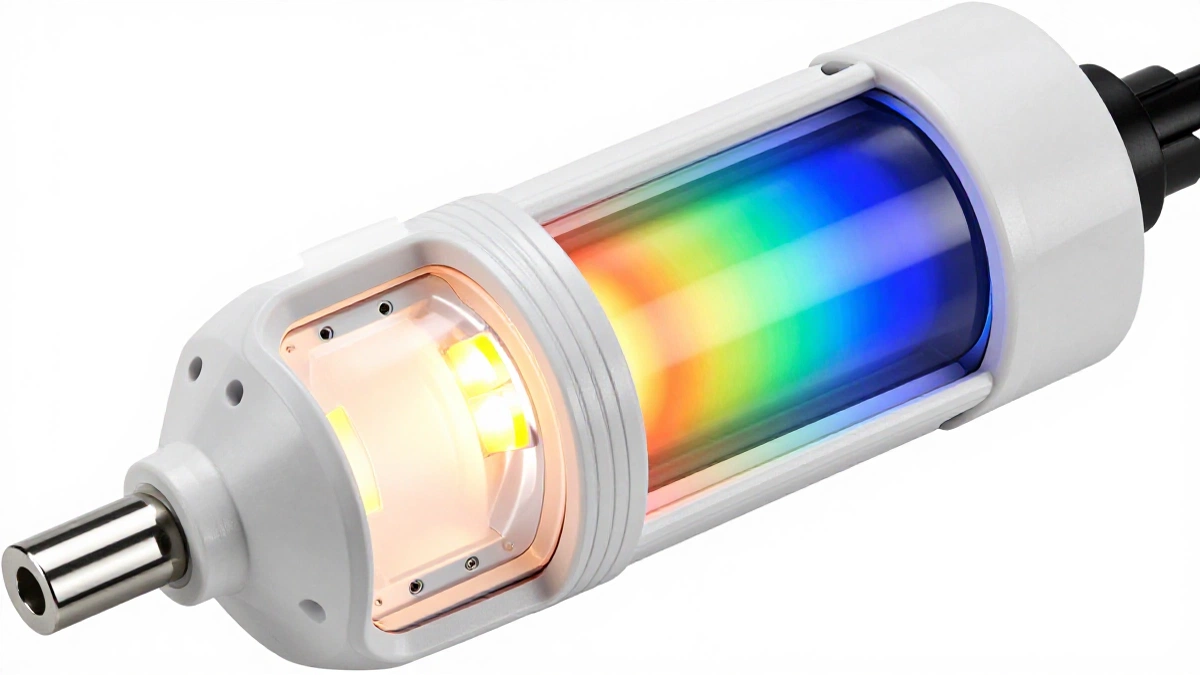
Figure: tunable white LED systems adjust both intensity and spectral composition throughout the day to support human circadian rhythms.
Understanding the Circadian System and Light
The human circadian system is the internal clock that regulates sleep-wake cycles, hormone release, body temperature, and alertness over roughly 24 hours. Light is the primary external signal that synchronizes this clock to the local environment.
Key research findings driving HCL adoption in commercial settings:
- Morning light exposure at appropriate intensities and spectral composition supports melatonin suppression and promotes alertness at the start of the workday
- Midday light at higher color temperatures (4000K–6500K) sustains cognitive performance and alertness
- Evening light at warmer color temperatures (2700K–3000K) with reduced blue content supports the natural rise in melatonin and prepares occupants for sleep
- Light exposure timing matters as much as intensity — poorly timed lighting can actively harm circadian alignment rather than help it
The term melanopic lux (or melanopic equivalent daylight illuminance, EDI) measures the effective biological stimulation of light on the circadian system, rather than just visual brightness. This metric is now used in building certification systems to quantify circadian-effective light exposure.
How Tunable White LED Systems Work
Tunable white LED systems adjust both color temperature (measured in Kelvin, K) and intensity throughout the day. Unlike fixed-temperature luminaires, a tunable system can shift from a warm 2700K in the morning to a neutral or cool 5000K–6500K during peak daytime hours, then return to warm tones in the evening.
The mechanism relies on dual-channel or multi-channel LED drivers that independently control warm-white and cool-white LED arrays. The controller mixes output from each channel to produce the target color temperature and intensity level.
| Feature | Single-channel Fixed CCT | Dual-channel Tunable White | Multi-channel Full Spectrum |
|---|---|---|---|
| Color temperature range | Fixed (e.g., 4000K only) | Typically 2700K–6500K | 2700K–6500K with finer granularity |
| Circadian support | None | Basic — time-of-day scheduling | Advanced — melanopic lux targeting |
| Commissioning complexity | Low | Medium | Higher |
| Cost | Lowest | Medium | Higher |
| Typical use case | General ambient lighting | Basic HCL applications | Healthcare, education, high-performance offices |
| Dimming behavior | Intensity only | Intensity + CCT shift | Independent intensity and CCT control |
A dual-channel tunable system can deliver meaningful circadian benefit over fixed CCT luminaires at a moderate cost premium. Multi-channel systems provide finer spectral control and are more common in healthcare settings where precise circadian dosing is clinically relevant.
Key Specification Considerations for Commercial Buyers
Before specifying a tunable white or HCL system, commercial buyers should evaluate the following:
1. Circadian metrics used in design Look for systems that reference melanopic lux or melanopic EDI rather than relying solely on photopic lux (visual brightness). Building certification schemes such as the WELL Building Standard v2 use specific threshold values for circadian stimulus.
2. Control system integration Tunable white systems require a controller capable of driving two or more LED channels independently. Verify compatibility with existing building management systems (BMS), DALI-2 DT8 drivers, or proprietary control protocols. DALI-2 Device Type 8 (DT8) supports tunable white control natively within the DALI-2 standard.
3. Scheduling and automation The biological benefit of HCL depends on consistent, time-based light exposure changes. Specify systems with scheduling capability that allows different color temperature and intensity profiles for morning, midday, and evening periods. Manual override should be available but not the default operating mode.
4. Zoning flexibility Different zones within a building may have different occupancy patterns. An open office and a conference room should ideally follow different circadian profiles. Verify the system supports zone-level scheduling without requiring building-wide changes.
5. Color rendering at different CCT settings Color rendering index (CRI) should remain consistent across the tunable range, typically Ra 80+ for general commercial applications and Ra 90+ for healthcare or design-sensitive environments. Some lower-cost tunable systems show significant CRI variation across the CCT range — request test data for the full operating range.
6. Verification and commissioning After installation, verify that delivered illuminance levels and spectral outputs match the design intent. Commissioning agents should measure melanopic lux at task surfaces during each scheduled period and adjust scheduling parameters to match design targets.
How HCL Aligns With the WELL Building Standard
The International WELL Building Institute (IWBI) WELL standard includes features related to circadian lighting under the Light concept. Key requirements include:
- Circadian lighting design: The standard specifies minimum melanopic EDI values at workstations during daytime hours, with different thresholds for morning, afternoon, and evening periods
- Automated shading and dimming: Systems should respond to available daylight and adjust artificial light output accordingly
- Glare control: Requirements for glare ratings on luminaires used in task areas
For projects pursuing WELL certification, tunable white systems with appropriate control scheduling can directly support compliance with Feature L03 (Circadian Lighting Design). Even for projects not seeking certification, following WELL’s circadian metrics provides an evidence-based framework for HCL specification.
Common Misconceptions About Human Centric Lighting
“Higher color temperature means more circadian stimulation.” Partially true, but incomplete. Blue-wavelength content (around 460–480nm) is the primary driver of circadian stimulation. A cool-white LED at 5000K with low blue content may be less circadian-stimulating than a slightly warmer 4000K LED with higher blue spectral power. Always ask for melanopic lux data, not just color temperature.
“Human centric lighting is only for healthcare.” While healthcare was an early adopter due to clinical evidence, HCL principles apply broadly to any space where occupant well-being and performance matter — offices, schools, universities, hospitality, and retail environments all show measurable benefits in peer-reviewed studies.
“Dimming at night is enough.” Reducing intensity alone does not address spectral composition. Evening light should shift toward warmer color temperatures with reduced blue-wavelength content. Intensity reduction without CCT change addresses part of the problem but misses the spectral mechanism.
“The research is still too early to act on.” The fundamental relationship between light, circadian biology, and human performance is well established in scientific literature. What continues to evolve is the application engineering — how to specify, install, commission, and maintain HCL systems effectively in real building projects. The evidence base is sufficient for commercial specification decisions today.
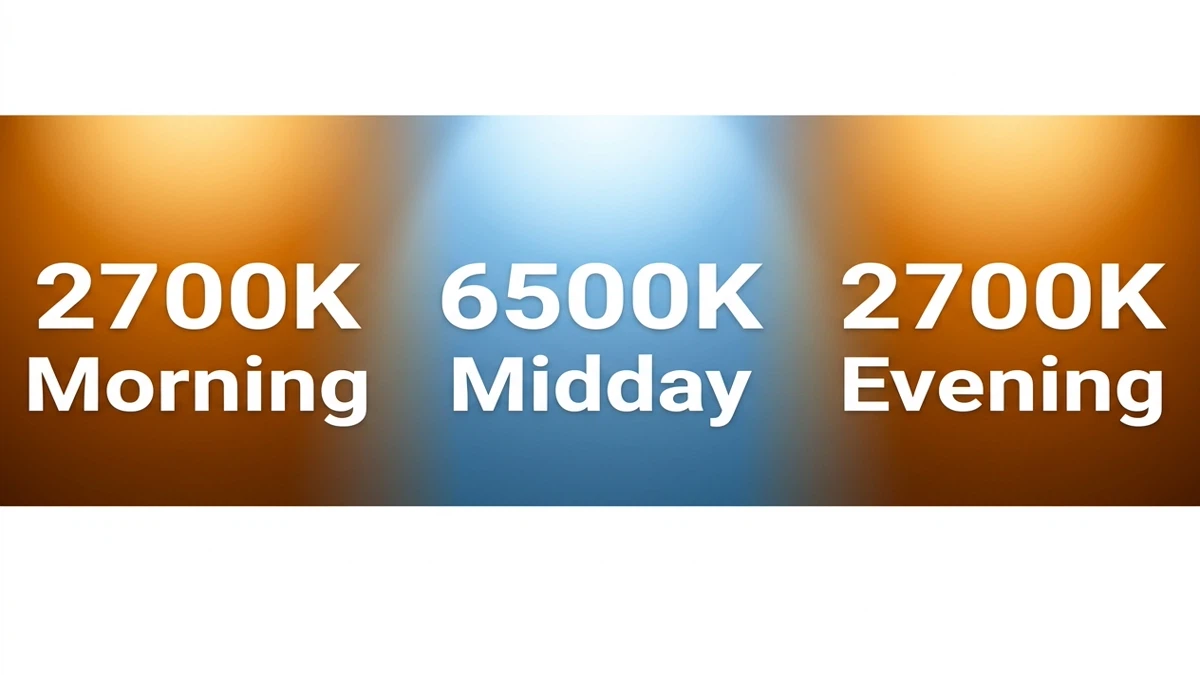
Figure: tunable white LED systems shift spectral composition throughout the day — warmer in the morning and evening, cooler at midday — to match the body’s natural circadian cues.
Conclusion: Making the Specification Decision
For commercial lighting buyers evaluating HCL, the key question is not whether circadian lighting matters — the science is clear that it does. The practical question is which level of HCL investment fits the project scope and client requirements.
For most commercial office, retail, and educational projects, a dual-channel tunable white system with DALI-2 DT8 control provides the best balance of circadian benefit, cost, and commissioning simplicity. For healthcare, senior living, and high-performance commercial projects where WELL certification or evidence-based design is a requirement, a multi-channel full-spectrum system with dedicated melanopic lux targeting is the more appropriate specification.
The specification checklist for either tier:
- Melanopic lux targets defined per zone and time period
- DALI-2 DT8 or equivalent tunable white control protocol specified
- Scheduling parameters defined for morning / midday / evening periods
- Zone-level control confirmed — not building-wide only
- CRI consistency data across full CCT range requested from manufacturer
- Commissioning plan includes melanopic lux verification at task surfaces
- Integration with BMS or existing control system confirmed
- Training and handover documentation include circadian operating rationale
Human centric lighting is moving from a niche specification to a mainstream expectation in projects where occupant well-being is a stated priority. Getting the specification right — at the appropriate tier for the project — is now a measurable skill that distinguishes informed commercial lighting buyers from those buying on price alone.
Explore Lighting’s range of commercial luminaires compatible with DALI-2 DT8 tunable white systems, or contact our specification team to discuss project requirements.
For a detailed comparison of tunable white control protocols and HCL system architecture, see our related article on DALI-2 vs 0-10V lighting controls.
FAQ
What is the difference between circadian lighting and human centric lighting?
Circadian lighting specifically targets the synchronization of the human circadian rhythm through light exposure timing, intensity, and spectral composition. Human centric lighting (HCL) is a broader design approach that incorporates circadian lighting principles alongside visual comfort, emotional responses to light, and overall occupant well-being. All HCL systems address circadian effects, but not all circadian lighting implementations encompass the full range of HCL considerations.
What color temperature is best for circadian support?
Research and building standards suggest a range rather than a single value: 2700K–3000K in the morning and evening to support melatonin regulation, and 4000K–6500K during midday to support alertness and cognitive performance. The key is spectral composition (blue-wavelength content) rather than color temperature alone. Melanopic lux metrics should guide specification rather than Kelvin values in isolation.
Does tunable white lighting require special wiring?
Tunable white LED systems using DALI-2 DT8 require DALI-2 compatible drivers and control wiring. Unlike 0-10V dimming, which uses a simple analog signal, DALI-2 is a digital protocol that supports individual luminaire addressing, feedback, and group control. The wiring topology is similar to standard DALI (daisy-chain or star topology permitted), but the drivers and controller must be DALI-2 certified DT8 devices.
How much does human centric lighting cost compared to standard LED?
Dual-channel tunable white systems typically carry a 15–30% cost premium over fixed-CCT LED equivalents, depending on the luminaire type and control system complexity. Multi-channel full-spectrum systems can carry a 30–50% premium. Control system costs (controllers, sensors, integration) add further cost. For projects pursuing WELL certification, the premium may be partially offset by the value of certification recognition.
Is human centric lighting relevant for retrofit projects?
Yes. Tunable white downlights, troffers, and linear fixtures are available in form factors compatible with standard ceiling grid and recessed mounting. Retrofit projects can adopt HCL by replacing existing luminaires with tunable white equivalents and adding a DALI-2 DT8 control layer. Wireless HCL systems using Zigbee or Bluetooth Mesh are also viable retrofit options where running new control wiring is impractical.