DALI-2 vs 0-10V Lighting Controls: Which Is Better for Commercial Projects?
Why This Control Decision Matters More Than Many Buyers Expect
In commercial lighting projects, teams often compare fixtures carefully but simplify the control decision too early. That shortcut can create avoidable cost later. The choice between DALI-2 and 0-10V is not only about dimming. It affects wiring logic, commissioning effort, future zoning flexibility, fault diagnosis, and how easy the installation will be to maintain after handover.
For procurement teams, contractors, and project managers, the real question is not which protocol sounds more advanced. The more useful question is which control approach fits the building’s operational goals, budget discipline, and expected lifecycle complexity.
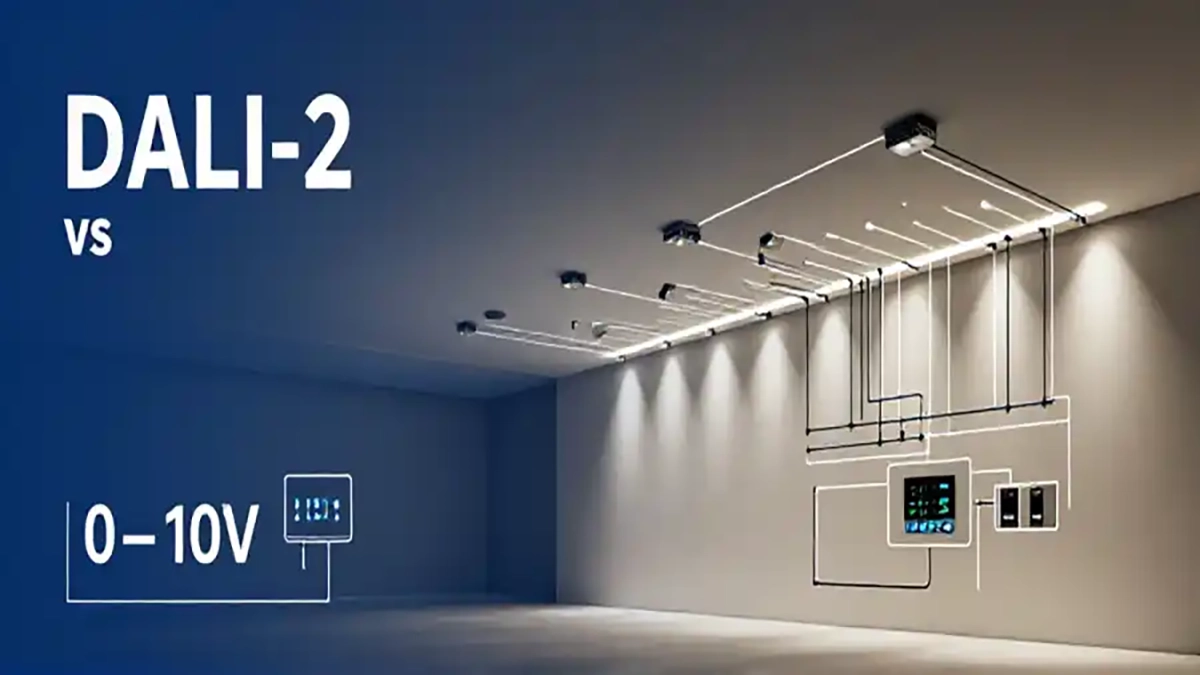
What DALI-2 and 0-10V Actually Mean in Practice
0-10V: Simple Analog Dimming
0-10V is widely used because it is familiar, relatively easy to understand, and practical for many straightforward commercial dimming applications. In basic terms, the control signal adjusts light output through an analog voltage level. For projects with limited zoning complexity, it can be a cost-effective and dependable option.
DALI-2: Digital, Addressable Control
DALI-2 is a digital lighting control protocol designed for more structured communication between control devices, drivers, sensors, and other components. Compared with basic analog dimming, it gives the project team more control over addressing, grouping, scene setting, diagnostics, and future adjustment.
That added capability does not automatically make DALI-2 the correct answer for every project. But it does matter in projects where flexibility and maintainability have real commercial value.
Three Questions Buyers Should Ask Before Choosing
1. How complex is the zoning and scene-control requirement?
If a project only needs basic area dimming with limited changes over time, 0-10V may be sufficient. If the building requires multiple scenes, frequent reconfiguration, detailed grouping, or sensor-driven control logic across changing spaces, DALI-2 usually has a stronger operational case.
2. How likely is the layout to change after handover?
Many offices, hospitality spaces, education projects, and mixed-use interiors do not stay functionally static. If spaces are likely to be re-zoned or re-programmed, DALI-2 generally offers a more scalable path than hardwired analog control logic.
3. How important are maintenance visibility and fault isolation?
Control systems are often evaluated at installation stage, but maintenance teams inherit the long-term consequences. If the operator values easier diagnostics and cleaner control management, a digital architecture may reduce service friction over time.
A Practical Comparison Table for Commercial Projects
| Evaluation point | 0-10V | DALI-2 |
|---|---|---|
| System type | analog dimming | digital addressable control |
| Wiring simplicity | simple in basic applications | more structured but requires protocol-aware planning |
| Scene setting | limited and often more hardware-dependent | stronger scene and grouping capability |
| Re-zoning flexibility | lower | higher |
| Device feedback / diagnostics | limited | stronger diagnostic potential |
| Best fit | simple dimming projects, budget-led retrofits | multi-zone projects, smart controls, lifecycle-focused buildings |
Where 0-10V Still Makes Sense
0-10V remains a valid choice in many commercial situations, especially when the project team is trying to control cost and avoid unnecessary complexity.
Strong-fit use cases for 0-10V
- small or mid-scale retrofit projects with simple dimming goals
- projects with stable room layouts and limited scene requirements
- applications where the contractor and facility team prioritize familiarity
- budgets that cannot justify a more advanced control architecture
Common mistake with 0-10V
The most common problem is expecting a simple analog dimming system to behave like a smarter addressable platform. That mismatch often appears after handover, when the client wants easier scene changes, more granular grouping, or better troubleshooting visibility than the system was designed to provide.
Where DALI-2 Usually Delivers More Value
DALI-2 tends to justify itself when lighting is part of a broader building-performance strategy rather than only a basic dimming layer.
Strong-fit use cases for DALI-2
- office floors with evolving occupancy patterns
- hospitality projects with scene-based guest experience requirements
- education and healthcare environments with multiple operational modes
- premium commercial projects where commissioning quality and long-term control matter
- projects that expect future sensor integration or smarter building workflows
Why buyers increasingly choose DALI-2
More teams now view controls as part of lifecycle risk management. A system that is easier to commission clearly, adapt later, and diagnose during operation may create better total value than a lower first-cost option that becomes rigid or expensive to manage.
Commissioning and Maintenance: The Part Many RFQs Underweight
The control decision should not stop at hardware price. Commissioning quality often determines whether a system feels reliable in the field.
Questions procurement teams should raise early
- Who is responsible for commissioning logic and scene setup?
- Can the controls package be adjusted without major rewiring later?
- How are sensors, drivers, and wall controls expected to interact?
- What documentation will the operator receive at handover?
- How easy will fault tracing be two years after project completion?
These questions matter because a technically acceptable lighting package can still become an operational headache if the control layer is underplanned.
Common Buyer Mistakes
Mistake 1: Choosing only on first cost
A lower upfront control cost may not remain lower once labor, recommissioning, and maintenance friction are considered.
Mistake 2: Over-specifying digital control for a simple project
Not every warehouse, corridor retrofit, or basic tenant improvement needs a richer control architecture. Complexity should earn its place.
Mistake 3: Ignoring the operator’s future needs
The system may satisfy the fit-out team today but frustrate the facilities team later if it is too rigid to support normal changes.
A Simple Decision Framework
| Project condition | Better fit |
|---|---|
| Basic dimming, limited zones, stable layout | 0-10V |
| Multiple scenes, future reconfiguration, richer control logic | DALI-2 |
| Budget-first retrofit with minimal smart control demand | 0-10V |
| Lifecycle-focused building with maintenance and scalability priorities | DALI-2 |
FAQ: Quick Answers for Project Teams
Is DALI-2 always better than 0-10V?
No. DALI-2 is usually better when the project needs flexible grouping, scene control, diagnostics, or future reconfiguration. For simpler dimming applications with stable layouts, 0-10V may be the more efficient choice.
Is 0-10V cheaper?
It is often cheaper at first-cost level in straightforward projects, but total cost depends on wiring labor, commissioning effort, later re-zoning needs, and maintenance complexity.
Which system is easier to maintain?
For basic systems, 0-10V can be easy to understand. For larger multi-zone projects, DALI-2 often provides better long-term manageability because addressing, grouping, and diagnostics are more structured.
Conclusion
DALI-2 and 0-10V both have valid roles in commercial lighting, but they solve different levels of control need. 0-10V is often the right answer when the goal is simple, stable, cost-conscious dimming. DALI-2 becomes more compelling when the project needs flexible zoning, structured commissioning, future adjustment, and clearer lifecycle management.
For commercial buyers, the best decision is usually the one that matches building complexity honestly. The wrong move is not choosing either protocol. It is buying a control approach that does not match how the space will actually be used, maintained, and changed over time.
If your project team is comparing lighting control options for offices, hospitality, education, or retrofit work, the next useful step is to define zoning complexity, future change risk, and commissioning responsibility before final fixture approval.
Related Reading: