Commercial Emergency Lighting Procurement: Testing, Runtime and Specification Checklist
Why Emergency Lighting Procurement Needs More Than a Product Schedule
Emergency lighting is a life-safety system, not simply a lower-output version of normal lighting. When normal power fails, occupants need enough guidance to identify escape routes, changes in level, exits, fire equipment, and other points of emphasis. The buyer therefore has to approve more than a luminaire shape and lumen figure. The procurement package must connect the risk assessment, lighting design, power source, test method, commissioning evidence, and maintenance plan.
This distinction matters in offices, hotels, retail premises, warehouses, apartment buildings, transport facilities, and public buildings. A product may be described as an emergency luminaire, yet the delivered installation can still fail its intended purpose if the wrong optics are used, the battery duration is misunderstood, test access is poor, or the handover file is incomplete.
This guide is for distributors, contractors, specifiers, facility managers, and procurement teams. It focuses on questions to settle before an order and acceptance tests to define before installation.
Start With the Risk Assessment and Local Rule Set
The first procurement question is not “Which emergency fitting should we buy?” It is “What must remain safe when normal lighting is unavailable?” The responsible designer or building operator should identify escape routes, open areas, high-risk tasks, changes in level, fire-fighting equipment, first-aid points, final exits, refuge areas, and any location where people need additional visual guidance.
Requirements vary by jurisdiction and building use. A European project may reference EN 1838:2024 for lighting applications and EN 50172:2024 for operational requirements for emergency escape lighting systems, alongside national rules; confirm the adopted edition with the relevant standards body. The BSI pages for BS EN 1838:2024 and BS EN 50172:2024 are useful edition references, not a substitute for obtaining the applicable standard. A project for North America may use a different code and certification path. IEC 60598-2-22:2021 is an important international product-safety reference for emergency luminaires, but it does not replace the local building, fire, electrical, or accessibility requirements that govern a project.
Record the applicable rules in the specification, including the edition and jurisdiction. Do not use an undated phrase such as “fully compliant” as a substitute for a compliance schedule. If several markets are involved, create a separate column for each market rather than assuming one certificate covers every installation.
What to Request Before Comparing Prices
A comparable quotation should include the following information for every emergency product or system component.
1. Exact product identity and operating mode
Request the exact model, photometric file, battery chemistry, rated supply voltage, charging method, operating mode, and accessories. State whether the unit is maintained, non-maintained, or combined. Confirm whether an emergency function is integrated into a normal luminaire or supplied as a dedicated fitting.
Ask the supplier to identify the version being quoted. A family name is not enough when optics, battery packs, test facilities, ingress protection, or control interfaces vary between variants. Any substitution should trigger a fresh review of the photometric and compliance evidence.
2. Product-safety and market-access evidence
For a product marketed against IEC 60598-2-22, request the certificate or test report reference and confirm its scope. The 2021 edition includes clarified requirements for high-temperature operation, test facilities for self-contained luminaires, and newer battery technologies including lithium batteries and electric double-layer capacitors. The procurement file should show which edition and amendments were assessed.
For projects using a national certification route, request the relevant listing or certification evidence for that market. A general electrical-safety mark should not be treated as proof that emergency operation, controls, battery behaviour, and exit-sign visibility were assessed.
3. Photometric evidence and design assumptions
Request the photometric file used for the design, not only a catalogue lumen value. The designer should state mounting height, spacing, surface reflectance assumptions, maintenance factor, emergency illuminance targets, uniformity criteria, and points of emphasis. The same product can produce different results when its mounting position, ceiling height, corridor width, or emergency output changes.
Ask for a calculation that identifies dark spots and obstructions. Exit signs, staircases, ramps, changes in direction, fire points, and final exits deserve explicit review. A high emergency lumen figure does not prove that the escape route is evenly illuminated.

Runtime Is a System Requirement, Not Just a Battery Label
Emergency duration should be specified in relation to the project rule set and the complete operating load. A statement such as “three-hour battery” is incomplete unless it explains the tested emergency output, ambient conditions, end-of-duration performance, battery age assumptions, and whether the figure applies to the exact luminaire configuration.
Ask the supplier to provide:
- rated emergency duration and the test condition;
- emergency power and light output during the required period;
- battery type, replaceability, expected service interval, and disposal route;
- charging time after a discharge test;
- low-temperature or high-temperature limitations;
- behaviour after battery replacement or loss of mains power; and
- compatibility with the proposed automatic or manual test system.
Do not compare runtime claims from different test methods as though they were identical. A change in LED output, optic, battery pack, temperature, or control setting can alter the result. For a central-battery installation, evaluate the central power supply, circuit monitoring, cable protection, circuit segregation, and maximum load—not only the emergency luminaires.
Testing and Commissioning Must Be Priced and Owned
Emergency lighting is not accepted when the fittings turn on once during installation. The project needs a documented commissioning sequence and a named owner for each test.
Step 1: Verify delivered items
Compare every delivered model and accessory with the approved schedule. Record serial numbers or asset identifiers where the maintenance system requires them. Check legends, arrows, lenses, diffusers, battery packs, chargers, test switches, indicators, and mounting accessories before the ceiling is closed.
Step 2: Test normal and emergency operation
Simulate failure of the normal supply using the approved test method. Confirm that each unit changes to emergency operation, that the intended circuits remain available, and that the indicator reports the correct state. For a combined luminaire, verify both normal and emergency modes rather than testing only the emergency output.
Step 3: Confirm illumination and visibility
Use the approved design points and inspection method to verify the installed result. Check escape-route continuity, stair edges, signs, final exits, fire equipment, and areas where obstructions or furniture may change the result. Record the instrument, date, location, and result. If the measured outcome differs from the design, resolve the cause instead of simply increasing the product count.
Step 4: Test duration and recharge
Run the required duration test under controlled conditions. Record the start time, end time, observed failures, emergency output, battery state, and recharge result. A short functional test cannot substitute for the full-duration test where the applicable rule set requires one.
Step 5: Test automatic monitoring and fault reporting
If the project uses automatic test equipment, confirm that failures reach the intended dashboard, panel, or maintenance record. Test loss of mains, battery fault, charger fault, lamp or LED failure indication, communication loss, and any inhibit or rest-mode function included in the design. Document who receives the alarm and how it becomes a corrective work order.
The Handover Package That Facility Teams Actually Need
The handover should allow a facilities team to locate, test, repair, and replace each unit without reconstructing the project from drawings. At minimum, request:
- final emergency-lighting layout with asset identifiers;
- circuit and zone schedule, including central-supply information where relevant;
- installed model, battery, optic, and accessory list;
- photometric files and final calculation assumptions;
- certificates, test reports, declarations, and applicable edition references;
- commissioning results, duration-test records, and defect close-out;
- test-switch, automatic-test, gateway, and panel instructions;
- battery replacement, storage, recycling, and spare-parts guidance;
- warranty boundaries and response process; and
- a maintenance schedule with responsible person and record location.
A generic instruction manual is not a complete handover. Mark the documents that apply to the exact installed configuration. If a product has several battery or optic variants, identify the installed variant in the asset register.
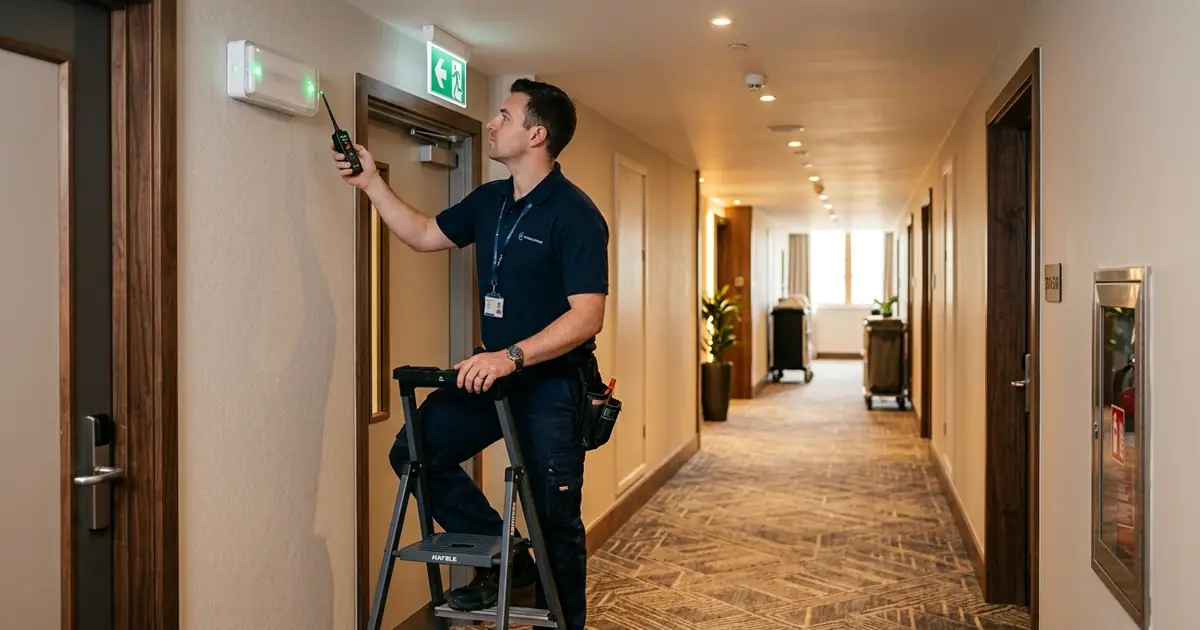
A Procurement Matrix for Approval and Acceptance
| Requirement | Supplier evidence | Site acceptance test | Handover record |
|---|---|---|---|
| Product identity | Exact model, variant, and accessory schedule | Match delivered items to approved schedule | Signed product register |
| Local compliance route | Certificate, listing, or test report with scope and edition | Confirm markings and documents | Compliance file |
| Emergency duration | Test condition, output, battery details | Witness required duration test | Duration report |
| Escape-route performance | Photometric file and calculation | Inspect and measure design points | Final calculation and record |
| Test facility | Wiring diagram and operating instructions | Simulate supply failure and test indicator | Test procedure |
| Monitoring | Alarm map and communication path | Inject permitted fault conditions | Alarm and maintenance record |
| Replacement | Battery, driver, and spare-part information | Verify replacement access and identification | Maintenance schedule |
Use the matrix during tender evaluation and again during handover. A blank cell is a procurement risk, not an administrative detail.
Common Buyer Mistakes
Mistake 1: Choosing by catalogue lumens
Emergency output, beam distribution, mounting height, and spacing determine the usable result. Compare photometric evidence and design assumptions, not one headline number.
Mistake 2: Treating a certificate as a building approval
Product-safety evidence is valuable, but local building and fire requirements still govern the installation. Ask the responsible designer to confirm the complete compliance path.
Mistake 3: Leaving testing out of the quotation
Testing, programming, fault simulation, duration checks, documentation, and training consume labour. Price them as deliverables with acceptance criteria.
Mistake 4: Ignoring the replacement plan
Battery chemistry, access, service life, and spare availability affect lifecycle cost. Decide how a unit will be identified and replaced before the original installer leaves.
Mistake 5: Accepting an undated compliance claim
Standards are revised and national adoptions differ. Record the exact edition, market, scope, and review date. Recheck the requirement when the project design or destination market changes.
FAQ for Emergency Lighting Buyers
Is IEC 60598-2-22 enough to approve an emergency-lighting installation?
No. It is a product-safety reference for emergency luminaires. The project still needs to meet the building, fire, electrical, accessibility, and other local requirements that apply at the installation site. Record the complete compliance route, including the applicable edition and jurisdiction.
Is a three-hour battery claim enough for a quotation comparison?
No. Compare the tested emergency output, operating conditions, battery configuration, end-of-duration performance, recharge time, and exact luminaire variant. Runtime claims made under different conditions are not directly comparable.
What should a handover file contain?
At minimum, it should identify each installed unit, its circuit and variant, the final design assumptions, compliance evidence, commissioning and duration-test results, monitoring instructions, and the replacement and maintenance plan. A generic manual alone does not identify the delivered installation.
Final Checklist for B2B Project Teams
Before issuing an order, confirm that the project has named the responsible designer, applicable rules, emergency modes, duration, photometric targets, points of emphasis, test method, commissioning owner, monitoring route, handover documents, and replacement strategy. Require model-specific evidence and make substitutions subject to approval.
The safest procurement decision is not necessarily the product with the highest output or the lowest unit price. It is the package whose performance can be designed, tested, documented, maintained, and verified against the rules that apply to the building. Convert those expectations into a measurable schedule before comparing quotations.
Sources:
- BS EN 1838:2024
- BS EN 50172:2024
- IEC: IEC 60598-2-22:2021
- Emergency lighting testing and certification guidance
- Emergency lighting design guidance
Information checked 26 August 2026. Sources provide general product, certification, and standards guidance; they do not determine a project’s legal compliance. Confirm the applicable national rules, adopted standards, and project-specific fire-safety requirements before procurement. Next review: 26 February 2027.
Get a Project-Ready Specification Review
Turn your emergency-lighting requirements into a model-specific approval matrix before you issue the order. Request a project specification review