DALI-2 in Hotel Lighting: Case Study, ROI & Integration Value
Why DALI-2 Still Matters in Hotel Projects
Hotel lighting is rarely difficult because of fixture quantity alone. It becomes difficult because almost every area behaves differently. Guestrooms need intuitive local control. Corridors need low-energy operation without feeling unsafe. Restaurants and lounges need repeatable scenes. Lobby spaces often need both atmosphere and operational consistency.
DALI-2 keeps appearing in hotel projects because it addresses that complexity more cleanly than many simpler control approaches. It is not the only answer, and it is not always the right answer. But when interoperability, re-zoning, scene control, and maintainability all matter, it deserves serious consideration.
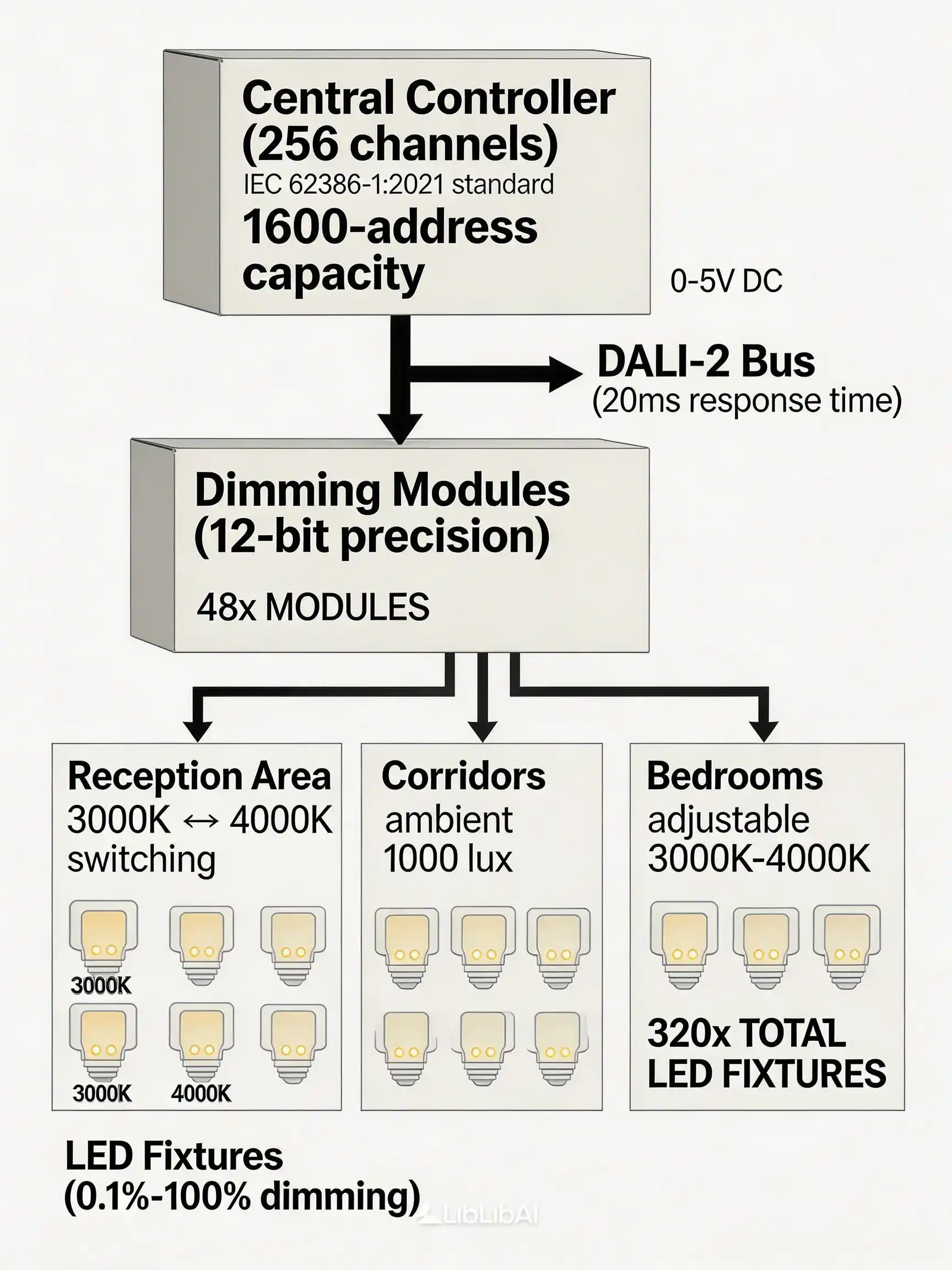
Where DALI-2 Creates Real Value
The strongest business case for DALI-2 is not marketing language about “smart” lighting. It is operational clarity.
Interoperability reduces integration friction
Hotels often combine multiple device types and, in many cases, multiple suppliers. A protocol with stronger interoperability discipline helps reduce the confusion that shows up during commissioning, especially when public areas, guestrooms, and facility systems all need to behave predictably.
Scene changes remain manageable after opening
Hospitality spaces rarely stay fixed after project handover. Operators adjust brightness, revise scenes, and change how spaces are used. A system that supports clean reprogramming without rewiring becomes far more valuable after opening than it may appear during tender evaluation.
Maintenance teams get better fault visibility
Addressable control architecture helps facility teams identify the affected device group or circuit more quickly. In a hotel environment, that matters because lighting faults are visible to guests immediately and often need a faster response than in purely back-of-house applications.
Case Pattern 1: New-Build Hotels With Multiple Scene Types
New-build hotels tend to benefit from DALI-2 when the project includes many different lighting behaviors:
- Time-of-day transitions in lobby and lounge spaces
- Preset scenes in food-and-beverage areas
- Occupancy or schedule logic in corridors
- Layered guestroom lighting that must remain intuitive for the end user
In these projects, DALI-2 does not add value because it is advanced on paper. It adds value because it gives the designer, integrator, and operator a common structure to work from.
Typical advantages in delivery
| Project need | Why DALI-2 helps |
|---|---|
| Multiple scenes across public spaces | Scene logic is easier to define and adjust |
| Device-level addressing | Commissioning is more structured |
| Mixed control accessories | Integration is less dependent on custom improvisation |
| Future re-zoning | Changes are easier after opening |
Case Pattern 2: Retrofit Projects Replacing Aging Analog Control
Retrofit work often reveals the real difference between a system that looked “good enough” during installation and one that can be managed for years. Hotels with aging analog dimming or fragmented local controls commonly run into the same problems: poor flexibility, inconsistent zones, and slow troubleshooting.
In those cases, DALI-2 can improve value in four practical ways:
- Zoning can be rethought without rebuilding the entire control concept.
- Sensors and scene logic can be integrated more coherently.
- Commissioning changes are easier to track and document.
- Maintenance teams gain a clearer path for fault isolation and replacement.
That said, not every retrofit needs DALI-2. If the project is small, mostly static, and locally switched, a simpler approach may be more appropriate.
How To Think About ROI
The ROI discussion for hotel lighting controls is often framed too narrowly around energy use. In practice, the value usually comes from several buckets at once.
Value buckets that matter in hotel control decisions
| Value area | Typical source of benefit |
|---|---|
| Energy | Scheduling, dimming, occupancy logic, daylight response |
| Labor | Cleaner commissioning and faster future changes |
| Maintenance | Better fault visibility and replacement planning |
| Operations | Easier scene updates as the property evolves |
Projects with long operating hours, many public scenes, and active facility teams tend to benefit most. Projects with very simple layouts and minimal control ambition often do not justify the extra system depth.
When DALI-2 Is the Right Fit
- The hotel needs layered scene control across several public areas.
- The project team expects future changes after handover.
- The owner cares about long-term maintainability, not just first cost.
- Integration with broader control or building-management logic is part of the project brief.
When It Is Often Over-Specified
- The property is small and operationally simple.
- Most spaces only need local switching or basic dimming.
- There is no commissioning owner and no realistic maintenance plan.
Choosing DALI-2 without defining who will commission it and who will maintain it is one of the most common mistakes in project planning.
Conclusion
DALI-2 creates value in hotel lighting when the building is complex enough to need a real control structure, not just more features. Its strength lies in interoperability, scene management, operational flexibility, and maintainability over time. For hotel teams, that is usually the real return on investment.